REITs as a Deflationary Hedge: Positioning Portfolios for the AI-Driven Productivity Boom

REITs as a Deflationary Hedge: Positioning Portfolios for the AI-Driven Productivity Boom
The broad investor circle seems geared into accepting that the "higher-for-longer" interest rate regime is now here to stay. The Fed is understandably in a "cautionary pause," having lowered rates to roughly 3.50%–3.75% by late 2025. While some cuts are anticipated in 2026 due to easing inflation, the "higher for longer" narrative persists because cuts are gradual, with many economists expecting rates to remain well above the 2.5% "neutral" level through the end of 2026 to prevent a resurgence of inflation. Rising oil prices, as a result of the uncertainty surrounding the Strait of Hormuz further adds pressure to this outlook.
Given how these dynamics are shaping up to be, many investors are starting to treat Real Estate Investment Trusts (REITs) as little more than high-duration bond proxies. This narrow lens has fueled a prolonged period of capital outflow, leaving the sector trading at significant discounts to Net Asset Value (NAV) in a decade.
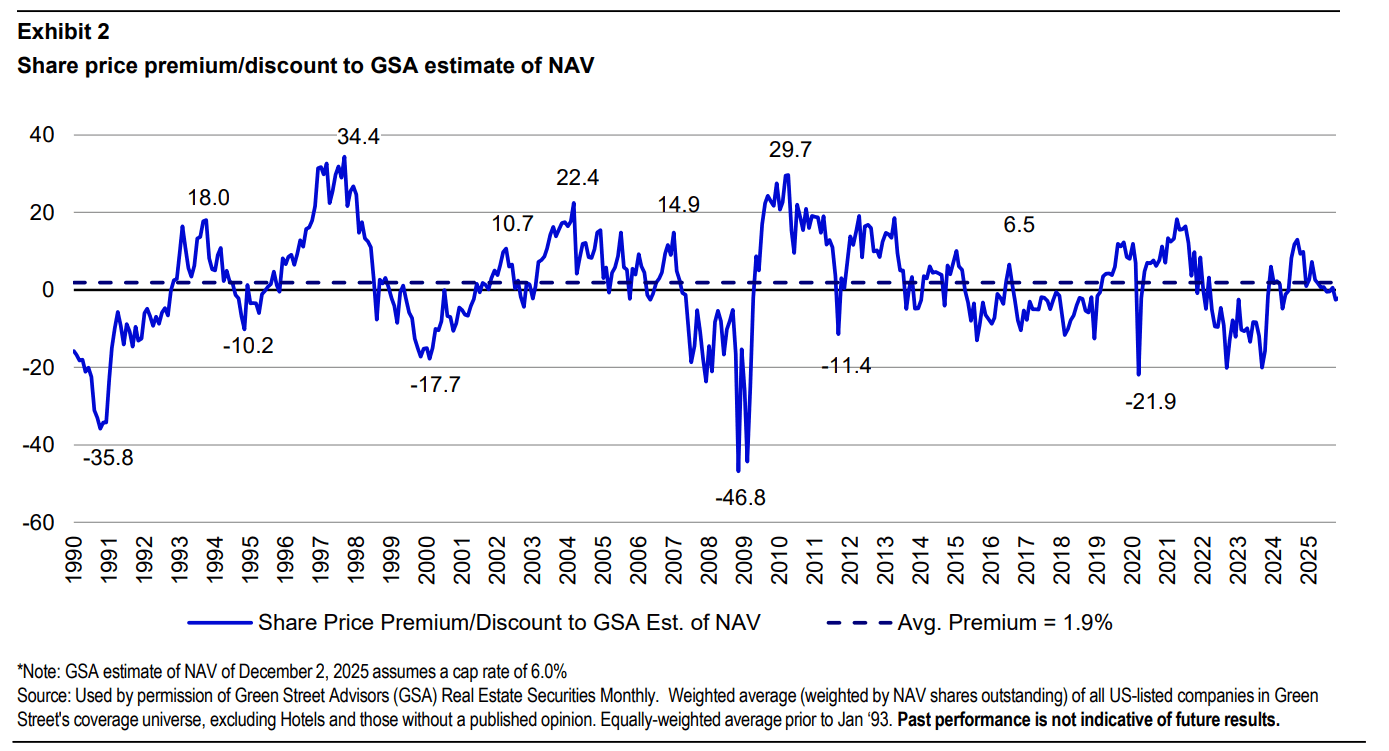
However, this focus on the discount rate ignores a fundamental shift in the macroeconomic landscape: the burgeoning AI-driven productivity boom.
While the broader market chases the parabolic growth of the "Magnificent Seven" and AI-adjacent SaaS companies, a profound disconnect has emerged. The very technology expected to drive the greatest deflationary period of the 21st century—by slashing labor costs and hyper-optimizing supply chains—is viewed as a catalyst for tech equities but a non-factor for the physical infrastructure that houses the economy.
For the professional allocator, the thesis for REITs is shifting from a defensive recovery play to a strategic macro-hedge. As AI begins to exert downward pressure on the costs of goods and services, the long-term trajectory for terminal interest rates is likely lower than current swaps suggest. Furthermore, in an era where software barriers to entry are collapsing due to AI-generated code, the value of non-disruptible physical assets becomes the ultimate sanctuary for wealth preservation.
We are entering a cycle where the "invisible" resilience of REIT balance sheets is about to meet the most powerful deflationary force in modern history, creating a unique window to capture high-quality real estate at implied cap rates that the private market simply cannot match.
Post-Supply Scarcity and the "Invisible" Balance Sheet Resilience
The prevailing market narrative has painted REITs as fragile entities struggling under the weight of debt and oversupply. However, a granular look at the data reveals a "coiled spring" effect. The combination of a looming supply vacuum and institutional-grade balance sheet management suggests that the fundamentals are far more robust than current trading multiples imply.
The Supply Cliff: From Glut to Scarcity
The "historic wave" of development fueled by the zero-interest-rate policy (ZIRP) of the post-pandemic era is currently hitting the market. This has led to the temporary stagnation in rents and uptick in vacancies that the broader market is currently pricing as a permanent impairment.
For those paying attention, the opportunity lies in the forward-looking supply pipeline. The convergence of elevated construction financing costs and strict regional bank lending standards has effectively halted new starts across multi-family, industrial, and life science sectors.
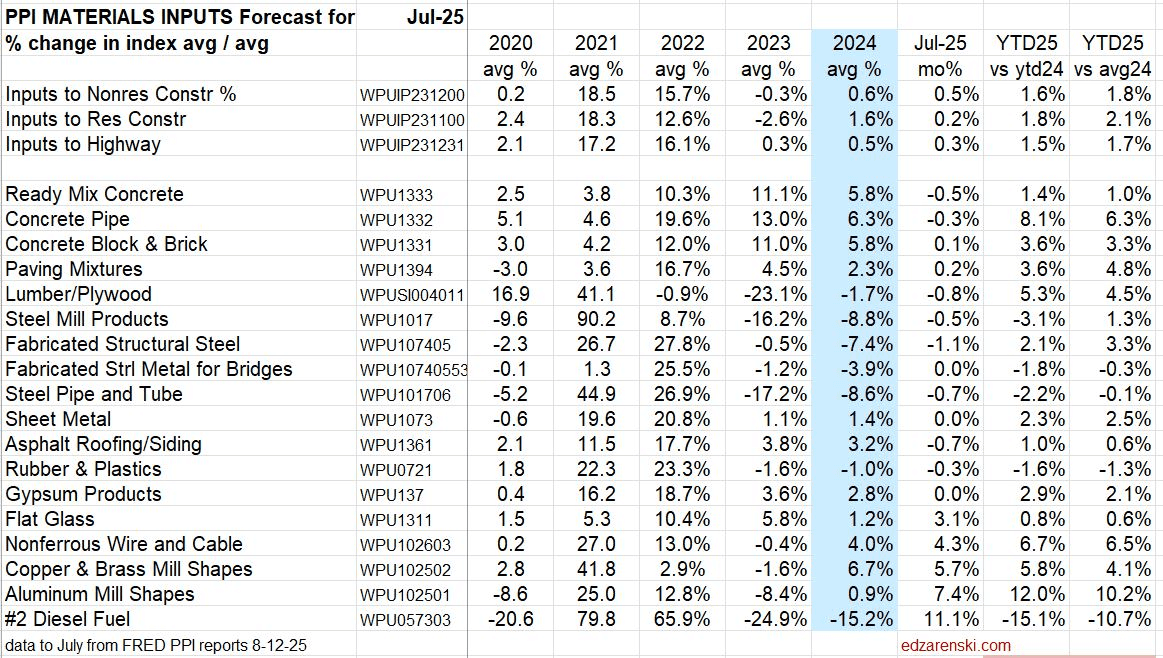
As the 2024–2025 deliveries are absorbed by steady demand, the lack of new groundbreakings today guarantees a supply "air pocket" beginning in 2026.
It would be reasonable to expect a sharp acceleration in rent growth in late 2026 and throughout 2027. Landlords who can bridge this "delivery peak" will find themselves in a high-occupancy environment with significant renewal leverage.
The "Invisible" Resilience: Asset-Liability Matching
One of the greatest miscalculations by generalist investors during this cycle has been the assumption that REITs would be crushed by rising interest expenses. In reality, the sector entered the hiking cycle with the strongest balance sheets in a long time.
Extended Maturity Ladders: Most high-quality REITs successfully termed out their debt during the 2020–2021 window. The "invisible" strength of these balance sheets is the weighted average debt maturity, which often extends 5–7 years, allowing them to bypass the peak of the rate cycle without forced refinancing.
The Leverage Paradox: While property values were pressured by higher cap rates, the underlying Net Operating Income (NOI) actually grew during the inflationary spike. Because debt was fixed and low, the "spread" between debt service and cash flow remained remarkably stable.
Internal Compounding: Unlike private equity players who often utilize floating-rate bridge loans, public REITs have largely utilized the unsecured bond market. This has allowed them to maintain a lower Cost of Capital relative to private competitors, providing a competitive advantage in a "higher-for-longer" environment.
Operating Margin Expansion via AI
Finally, the "productivity boom" mentioned in the thesis is already impacting the bottom line. Large-scale REITs are leveraging AI for predictive maintenance and dynamic pricing models.
Expense Control: AI-driven energy management and automated leasing workflows are reducing the OpEx-to-Revenue ratio.
NOI Enhancement: By optimizing tenant mix and reducing downtime between leases through predictive analytics, REITs are finding ways to grow the bottom line even in periods of stagnant top-line market rents.
Overall, it seems evident that the current "supply overhang" is a rear-view mirror concern. The forward-looking fundamentals point toward a period of restricted supply and enhanced operational efficiency.
The Strategic Reallocation: REITs as "Disruption-Proof" Infrastructure
The rapid maturation of agentic AI and automated workflows in recent years has forced a reckoning in equity valuations. While the previous decade favored "capital-light" SaaS models, the market is beginning to recognize a critical vulnerability, which is that software moats are being eroded by AI’s ability to commoditize code and service delivery. In this environment, the strategic reallocation toward REITs seems to be a pivot toward non-disruptible physical infrastructure.
The "SaaS-ification" Risk vs. Physical Scarcity
For institutional managers, the risk of "technological obsolescence" is no longer confined to hardware. We are seeing valuation compression in sectors where AI can replace human expertise or existing software architectures. Conversely, the physical assets owned by REITs—land, specialized power-grid connections, and urban last-mile hubs—cannot be "coded" away.
While AI can generate infinite digital content, it is strictly governed by physical constraints. The current premium on Data Center and Cell Tower REITs reflects this, but the opportunity is widening into Timberland (for energy conversion) and Industrial REITs (supporting AI-driven onshoring).
As AI disrupts traditional labor markets and corporate profit structures, portfolio managers are increasingly treating REITs as a "safe haven" for capital that requires protection from the rapid decay of digital moats.
The Institutional "Smart Money" Signal: M&A as a Valuation Floor
The arbitrage between public REIT prices and private market valuations has reached a critical tipping point. Leading private equity players, including Blackstone and Brookfield, have accelerated their acquisition of REITs at significant premiums throughout the first half of 2026.
Many REITs are currently trading at implied cap rates 150–200 basis points higher than where the same assets are being appraised in the private market.
For a portfolio manager, this M&A activity provides a fundamental "valuation floor." If the public market refuses to re-rate these assets, private capital will continue to privatize them, providing an exit at NAV for patient investors.
Portfolio Implementation: The "Barbell" Strategy
Positioning for the AI-driven productivity boom requires a "barbell" approach to real estate. On one side, high-conviction exposure to the "picks and shovels" of the revolution (Data Centers and Industrial). On the other, a contrarian allocation to sectors like Multi-Family and Self-Storage, which benefit from the labor market mobility and housing demand shifts that follow massive technological disruption.
By reallocating to REITs today, managers are capturing a historic discount on the very assets that will serve as the resilient backbone of the AI economy—infrastructure that is inherently immune to the deflationary pressures of the software world.
Bridge the Gap Between Thesis and Execution with Surmount Wealth
The macro thesis for a REIT recovery is compelling, but for the modern portfolio manager, the challenge isn't just identifying the rotation—it's timing and executing it with precision.
While the stars are aligning for REITs, the volatility of the transition from an inflationary to a deflationary AI-regime requires more than a "buy and hold" approach. It requires the ability to systematize your conviction.
Surmount Wealth empowers professional advisors to turn institutional-grade insights into automated reality. Whether you are looking to capitalize on the 2026 supply cliff or hedge against shifting interest rate spreads, our platform allows you to:
Automate Any Thesis: Transform complex qualitative views—like the AI-driven deflationary hedge—into quantitative, rules-based trading strategies.
Deploy Prebuilt Alpha: Access a library of sophisticated, pre-vetted strategies designed to navigate the current REIT and infrastructure landscape.
Build Custom Logic: Design bespoke automated strategies that align with your firm’s specific risk parameters and investment mandates, removing the friction of manual rebalancing.
Don't let the "historic entry point" for REITs pass while you're stuck in the operational weeds of execution. Systematize your edge, reduce emotional bias, and provide your clients with the sophisticated automation they expect in the AI era.
Ready to see your thesis in motion?
Book a Demo with Surmount Wealth Today and discover how we help professional advisors automate the next generation of wealth.