Why "De-dollarization" Narratives Often Precede Dollar Rallies

Why "De-dollarization" Narratives Often Precede Dollar Rallies
We've all been increasingly seeing headlines across mainstream media outlets, from The Economist to Barron’s, proclaiming the imminent demise of the U.S. dollar.
This "de-dollarization" narrative seems to have moved from the fringes of macro-critique to the centerpiece of retail financial discourse. However, for the sophisticated portfolio manager, this level of consensus shouldn't trigger fear—it should trigger a reflexive check of the "Magazine Cover Indicator."
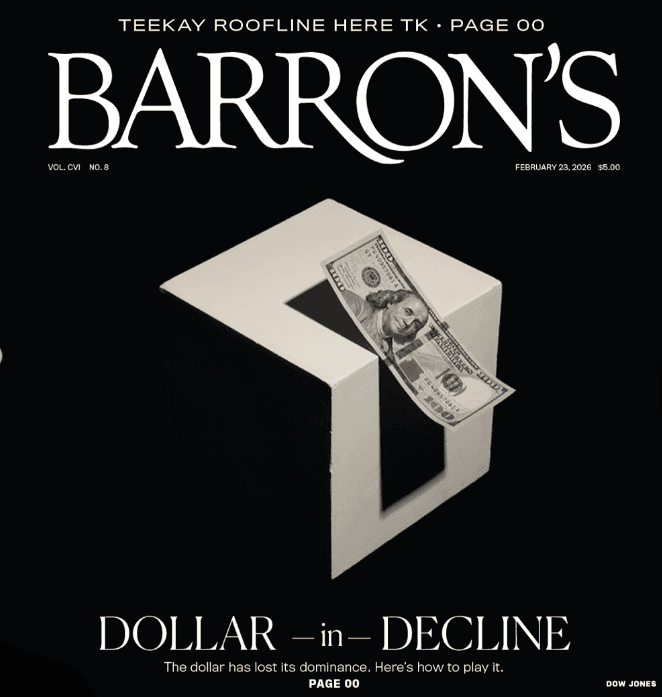
Historically, by the time a macro-economic trend is distilled into a punchy headline or a provocative cover illustration (as we see above), the underlying move is often in its final innings. This phenomenon occurs because mainstream media serves as a lagging indicator of sentiment; for a story to reach "cover status," the sentiment must be pervasive enough to resonate with the masses. By that point, the "marginal seller" has usually already exited their position.
We can look back at several "Gisele Bündchen moments"—referring to the 2007-2008 period when the supermodel famously requested payment in Euros just as the EUR/USD cross hit an all-time high of approximately 1.60.
2008 Paradox: In the summer of 2008, as oil prices peaked and the dollar was universally loathed, the greenback did not collapse. Instead, it began a violent rally as the Great Financial Crisis forced a global scramble for liquidity.
The 1999 "Death of Gold": Just as the Bank of England famously sold its reserves at the absolute bottom, the media was saturated with "Gold is Dead" narratives.
The 2026 Context: Today, with household equity allocations touching a record 55.1% and mainstream publications sounding the alarm on the dollar, we are seeing a mirror image of the 2000 and 2008 peaks.
The "Dollar Collapse" story is seductive because it offers a simple explanation for complex geopolitical shifts. Yet, for professionals in this space, the value lies in recognizing that sentiment is a mean-reverting asset. When everyone is positioned for a dollar plunge, the market becomes structurally "short" the greenback. Any deviation from the "collapse" script—such as a credit contraction or a burst in the AI bubble—triggers a massive short squeeze.
As we look at the lopsided short-to-long ratios in the futures markets today, the "Magazine Cover Trap" suggests that the crowd isn't just wrong about the direction; they are likely wrong about the magnitude of the move that is coming in the opposite direction.
Why Debt Crises Are Bullish for USD
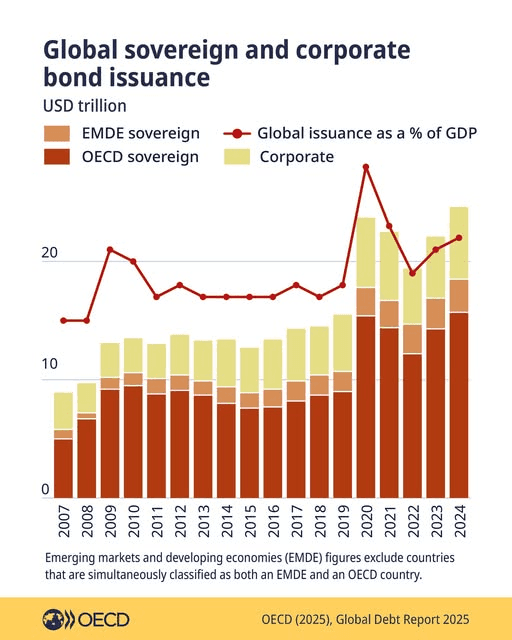
The fatal flaw in the "De-dollarization" thesis is the failure to distinguish between reserve preferences and functional liabilities. While central banks may express a desire to diversify their reserves into gold or regional currencies, the global private sector remains trapped in a massive, systemic short position on the U.S. dollar.
The Global Short Position: Debt as a Purchase Mandate
To understand why the greenback often rallies during a crisis, one must look at the trillions in offshore, dollar-denominated debt (the Eurodollar market). When a foreign corporation or sovereign entity issues debt in USD, they have effectively shorted the dollar; they have borrowed an asset they do not print and must eventually "buy" back to service interest and principal.
When the global economy enters a deleveraging phase (such as the collapse of the AI bubble or a residential real estate correction) cash flows tighten. As local currencies weaken against a backdrop of slowing growth, the cost of servicing that USD debt skyrockets. This triggers a Liquidity Vortex: a feedback loop where entities are forced to sell local assets (equities, commodities, and emerging market bonds) to acquire the dollars necessary to avoid default.
The "Dollar Smile" and the Flight to Quality
The USD typically gains strength under two diametrically opposed conditions, a phenomenon known as the Dollar Smile Theory:
Phase 1: US Economic Outperformance. The dollar rises as capital seeks higher yields and growth in a robust U.S. economy (the 2023–2025 cycle).
Phase 2: The Trough (The Danger Zone). The dollar sags as global growth synchronizes and risk appetite increases.
Phase 3: Risk-Off / Global Recession. The "smile" curls upward again. As global markets fracture, the USD becomes the only asset with sufficient depth and liquidity to absorb panicked capital.
The Mechanical Squeeze
Currently, we are seeing what seems to be like a repeat of the 2008 and 2000 scripts. As speculative bubbles in "alternative" assets (like cryptocurrencies) and overextended sectors (like AI-centric large caps) begin to deflate, the perceived "abundance" of dollars vanishes.
This is the involuntary squeeze. Investors who spent years betting on the "inevitable" decline of the dollar find themselves forced to liquidate their most "crowded" long positions to cover dollar-based liabilities. This is why, contrary to the IMF’s warnings of erosion, a systemic crisis actually reinforces the dollar's dominance by turning it into the world’s most sought-after "get out of jail" card.
In a deleveraging event, liquidity is more important than "fair value." The dollar isn't rising because the U.S. fiscal outlook is "good"; it is rising because the rest of the world's balance sheet is "short" the only currency required to settle their debts.
Portfolio Implications—Positioning for the "Flight to Quality"
The transition from a "de-dollarization" narrative to a resurgent greenback regime is rarely a soft landing. Historically, a strengthening U.S. dollar acts as a global financial tightening mechanism, effectively acting as a "wrecking ball" for over-leveraged and over-allocated asset classes. For portfolio managers, this shift requires a pivot from momentum-chasing to structural capital preservation.
The Denominator Effect and Equity De-risking
As the dollar moves toward its highest levels since 1985, the "denominator effect" will likely compress the valuations of all assets priced against it. With household equity allocations currently hovering at a historic 55%—more than double the long-term mean—the risk of a "crowded exit" is high.
If the dollar index (DXY) rallies during an AI bubble contraction, the QQQ faces a mathematical hurdle similar to the 2000-2002 period. Advisors should evaluate the probability of a multi-year regression to the mean, where large-cap tech valuations are reset by a combination of higher real rates and a stronger currency.
Long Duration as the Primary Alpha Driver
While the mainstream narrative remains fixated on persistent inflation, a dollar-led "flight to quality" often triggers a disinflationary—or even deflationary—bust. In this environment, the most "hated" asset class of the previous cycle often becomes the premier hedge.
A strengthening dollar lowers import costs and tightens global financial conditions, which historically puts downward pressure on yields. Long-duration Treasuries (TLT, EDV) and TIPS (LTPZ) provide a dual benefit: a safe-haven bid during equity drawdowns and an appreciation play as the market prices in a "growth scare."
Tactical Contrarianism: Shorts and Bear Funds
For professional managers with the mandate to do so, moving beyond a "60/40" defensive posture into active hedging is essential when valuations reach the 99th percentile.
Utilizing inverse funds (e.g., PSQ) or direct shorts on overextended sectors like semiconductors (SMH) or tech (XLK) can offset the unavoidable drawdowns in legacy long positions.
Similarly, the belief in "permanently high" energy and gold prices often ignores the dollar's role as a pricing floor. As the greenback rises, commodities typically undergo a sharp revaluation. Strategic shorting of gold miners (GDX, GDXJ) or energy ETFs (XLE) may serve as a potent hedge against the "inflation trade" unwinding.
Takeaway
The objective in the current market climate is not to find the next "growth" story, but to recognize when the world is short on dollars. By positioning in U.S. government debt and reducing exposure to assets that rely on a weak currency to sustain their multiples, managers can protect client wealth during the inevitable regression to the mean.
From Thesis to Execution: Automating the Contrarian Edge
The history of the 2000 and 2008 cycles proves that having the right macro thesis is only half the battle; the other half is the emotional discipline to execute when the "crowd" is screaming the opposite. For the modern portfolio manager, the bridge between a conviction-led thesis and a high-performance portfolio is Surmount Wealth.
Surmount Wealth provides professional-grade infrastructure to build, backtest, and deploy automated trading strategies. Whether you are looking to institutionalize your own proprietary logic or utilize our prebuilt templates, our platform removes the human bias that often leads to hesitation at market inflection points.
Strategy Idea: The "Dollar Vortex" Alpha
To illustrate the power of automation, consider a hypothetical strategy built on the dynamics we’ve discussed—let’s call it the Global Liquidity Squeeze (GLS) Model:
The Logic: The model monitors the US Dollar Index (DXY) against a basket of "over-allocated" assets (AI-heavy indices and commodities).
The Trigger: When the DXY crosses its 200-day moving average on accelerating volume—suggesting the "De-dollarization" narrative is breaking—the GLS Model automatically triggers a systematic rotation.
The Execution: It scales out of high-beta tech exposure and moves into long-duration U.S. Treasuries and inverse equity instruments (PSQ/SH) to capture the "flight to quality" squeeze.
The Result: Instead of manual rebalancing, the system executes the hedge the moment the data shifts, protecting your AUM from the initial, most violent leg of a mean reversion.
Disclaimer: This strategy is provided as a hypothetical illustration for educational purposes only.
Stop Guessing the Inflection. Start Automating it.
In a market defined by 99th-percentile valuations and extreme sentiment, the cost of "waiting to see" is too high. Surmount Wealth allows you to turn the analysis in this blog into a live, rule-based engine that works while the rest of the market is reading yesterday’s news.
Take control of your execution and scale your expertise.


