Jevons Paradox AI: Does Efficiency Kill Demand?

Jevons Paradox AI: Does Efficiency Kill Demand?
Every capital cycle produces a moment where efficiency itself becomes the investment risk. As AI models get cheaper to run and hardware grows more capable per watt, a natural assumption follows: if compute becomes more efficient, less of it should be needed, and the AI capex supercycle should eventually cool. Advisors evaluating this narrative for client portfolios would do well to examine Jevons Paradox AI dynamics before accepting that logic at face value, particularly those already working through tech overconcentration in client accounts.
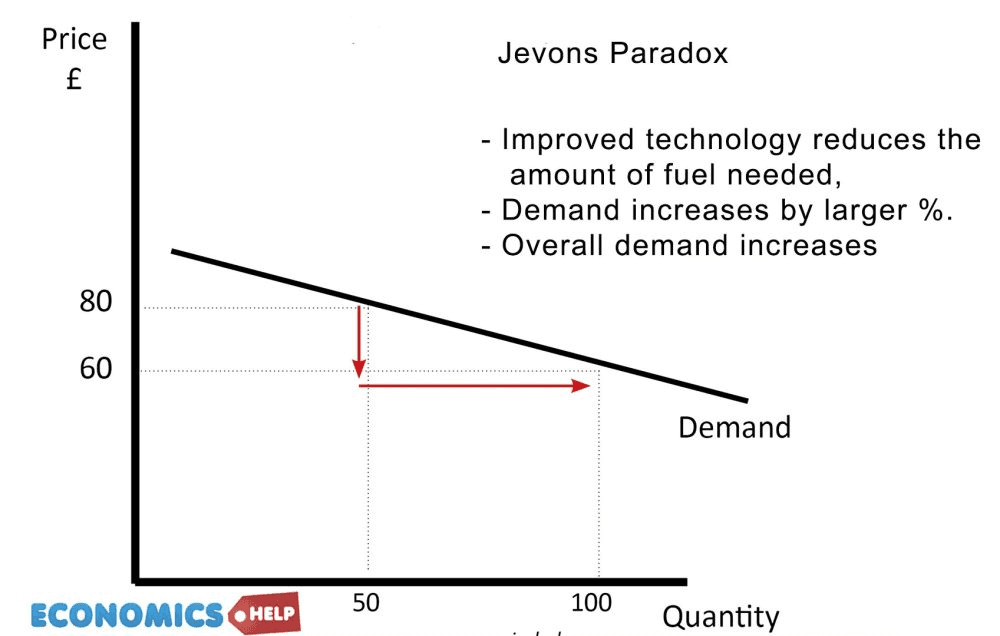
Named for the nineteenth-century economist who first documented the pattern in coal consumption, the Jevons Paradox AI debate turns on a counterintuitive relationship: efficiency gains often expand total resource use rather than shrink it, and the pattern has repeated across nearly every major energy and technology cycle since. Applied to the current spending cycle, understanding this relationship is central to building any credible technology adoption thesis around AI infrastructure.
What Jevons Paradox Means for the AI Capex Supercycle
The Historical Case for Jevons Paradox
William Stanley Jevons first observed the effect in 1865, noting that more fuel-efficient steam engines did not reduce Britain's coal consumption. They multiplied it, because cheaper power opened new industrial applications that had not previously been economical. Recent academic work applies the same framework directly to AI infrastructure. A 2026 research paper found that despite steep reductions in the cost of AI training and inference over four years, total organizational AI spending has not fallen — it has restructured, with deployment volume expanding to absorb the savings. That is Jevons Paradox AI playing out in real time, not theory.
Compute Efficiency and the Data Center Spending Forecast
The scale of capital at stake makes this more than an academic curiosity. PwC's inaugural Global Data Centre Outlook, modeled by Oxford Economics across 46 countries, projects $31.6 trillion in cumulative global data center capital expenditure through 2050 under its central scenario, with a plausible range extending to nearly $50 trillion if AI adoption accelerates.
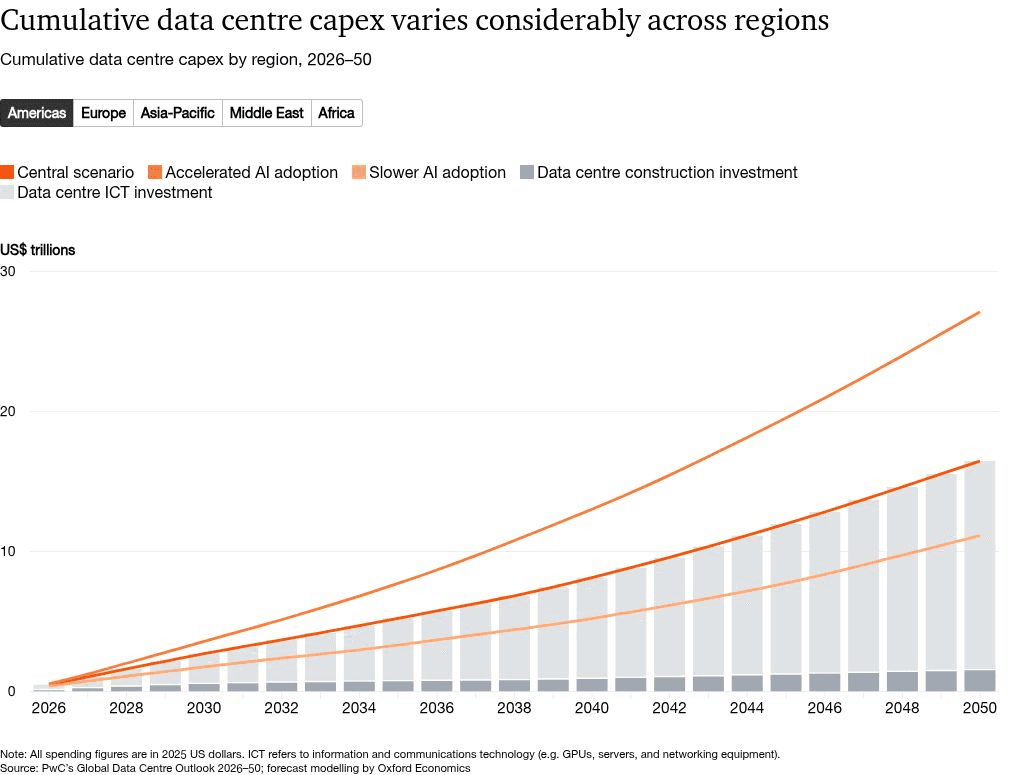
That data center spending forecast assumes compute efficiency keeps improving along its current trajectory — shorter hardware refresh cycles, falling cost per token, and declining inference costs. Under a Jevons framework, none of that efficiency growth should be read as a reason for shrinking capex. If anything, it is the mechanism by which demand for compute keeps expanding into new use cases.
Building a Technology Adoption Thesis Around Compute Demand
For advisors, the practical question is not whether Jevons Paradox AI dynamics are real — the historical and academic record is fairly convincing. The harder question is how to build a technology adoption thesis that accounts for them without overcommitting to a single narrative. A view built purely on "compute demand will keep rising because efficiency keeps improving" is directionally sound but analytically thin — the same gap in rigor we've flagged before in building a rigorous due diligence process for advisors.
It says nothing about which companies in the value chain actually capture that expanding demand, or what valuations already assume — the kind of question tools like the PEG ratio are built to help answer — or how sensitive forecasts are to the pace of AI adoption itself, a variable PwC's own modeling treats as the largest swing factor in its range.
Capital Cycle Risk in Fast-Moving Themes
Every capex supercycle carries capital cycle risk: the tendency for aggregate returns to compress as supply catches up with demand, regardless of how justified the original growth story was. Oil, telecom, and shipping cycles all followed this pattern — real demand growth coexisted with capital destruction because too much capacity chased the same opportunity at once.
Jevons Paradox AI reasoning can inadvertently encourage advisors to treat demand durability as the only variable that matters — a blind spot closely related to the concentration risk building in benchmark-heavy portfolios — when supply discipline, financing structure, and customer concentration typically determine which participants in a capex cycle actually compound value over a full cycle.
From Thematic Portfolio Allocation to Rules-Based Due Diligence
This is where thematic portfolio allocation benefits from more than a compelling macro narrative — a theme we explored more broadly in our look at capitalizing on emerging megatrends. A Jevons-informed view on AI infrastructure demand is a useful starting hypothesis, not a finished due diligence process. Testing it against company-level fundamentals — backlog quality, margin durability, customer concentration, and capital intensity — requires a repeatable framework rather than a one-time judgment call. This is precisely the discipline rules-based due diligence is built for: translating a macro thesis into explicit, testable screening criteria that can be applied consistently across a coverage universe and revisited as new data arrives, rather than relying on conviction alone to carry a position through a full cycle.
Jevons Paradox does not settle the debate over whether the AI capex supercycle is justified. It reframes the question. Falling compute costs are not, by themselves, evidence that spending will decelerate; historically, and by early indications in the current cycle, the opposite has been closer to true. The more useful exercise for advisors is separating durable demand dynamics from capital cycle risk at the individual security level, a task better suited to systematic screening than to macro conviction alone, and one that rewards patience over positioning around any single quarter's headline capex number.
Automate This Thesis With Surmount Wealth
Reading a framework like Jevons Paradox AI is one thing. Testing it against a live portfolio, without weeks of manual backtesting or custom code, is another — part of a broader shift we've covered in how automation is reshaping the RIA competitive landscape. This is exactly the gap Surmount Wealth is built to close.
Surmount gives RIAs and portfolio managers a way to explore a macro thesis — like the compute-demand dynamics discussed above — as a rules-based, automated strategy that runs directly on top of an existing brokerage account. No asset transfers. No coding from scratch. Just a testable, transparent framework built around the thesis you actually believe in.
As a hypothetical, illustrative example only (not an existing Surmount strategy, and not a recommendation to hold any specific position), a Jevons-informed screening concept might look something like this:
Screen for capex-cycle exposure, ranking candidates by capital intensity, backlog visibility, and customer concentration rather than headline association with the AI buildout narrative.
Weight toward recurring-revenue models (service, aftermarket, or subscription-based exposure) over pure capacity plays, reflecting the capital cycle risk discussed above.
Apply valuation discipline rules that flag names trading at multiples inconsistent with historical capex-cycle outcomes.
Rebalance on a defined cadence tied to updated spending-forecast data, rather than reacting to headlines in real time.
This kind of framework illustrates the type of systematic logic Surmount's platform is designed to help advisors explore and test — turning a written thesis into an actual, rules-based process rather than a one-time judgment call.
Why advisors and PMs use Surmount to explore ideas like this:
Test strategy logic against historical data before considering it for client portfolios
Automate rules-based execution on top of accounts you already manage — no transfers required
Access a library of prebuilt strategies or construct fully custom logic from scratch
Adjust, refine, and re-test assumptions as new data or market conditions emerge
Maintain full transparency into the rules driving every trade decision
If a systematic approach to thesis-testing is something your practice could use, book a demo with Surmount Wealth to see how the platform works with your existing workflow.
This example strategy concept is entirely hypothetical and illustrative, provided solely to demonstrate a type of rules-based framework. It has not been backtested, is not currently offered by Surmount, and does not represent investment advice or a recommendation to buy, hold, or sell any security. Assumptions, criteria, and outcomes shown are for illustrative purposes only and are subject to significant limitations; actual results would vary based on market conditions, implementation, and data availability.
FAQ: Jevons Paradox AI
What is Jevons Paradox AI?
Jevons Paradox AI describes how AI efficiency gains often expand total compute demand rather than shrink it, echoing the original 1865 coal-consumption observation.
Why does compute efficiency increase demand?
Lower costs from compute efficiency make more use cases economically viable, which historically pushes total consumption higher rather than lower.
How does this affect the AI capex supercycle?
It suggests falling costs alone don't signal a slowdown — the AI capex supercycle may persist even as unit efficiency continues improving.
Who first identified this economic pattern?
Economist William Stanley Jevons documented it in 1865, observing that efficient steam engines increased, rather than reduced, coal consumption.
When should advisors reassess capital cycle risk?
Advisors should reassess capital cycle risk whenever supply growth in a theme starts outpacing demonstrated demand, regardless of the narrative's strength.


