Upstream, Midstream, Downstream: How Different Energy Sub-Sectors Respond to Crude Price Shocks

Upstream, Midstream, Downstream: How Different Energy Sub-Sectors Respond to Crude Price Shocks
When crude oil prices move sharply, as they have during recent geopolitical disruptions in the Middle East, the instinctive response from many portfolio managers is to reach for "energy exposure" as though it were a single, uniform asset class. An allocation to energy goes up, the commodity hedge is in place, and the portfolio is repositioned. The problem with this approach is that it treats the energy sector as monolithic when, in practice, it is anything but.
The energy sector encompasses businesses with fundamentally different economic structures, different revenue drivers, and critically, different responses to the same crude price shock. A pipeline operator and a shale producer may both fall under the energy sector label in a standard classification system, yet their earnings can move in entirely opposite directions during the same crude price event. For investment advisors and portfolio managers who aim to use energy allocation with precision, whether as an inflation hedge, a volatility dampener, or a source of yield, understanding the distinction between upstream, midstream, and downstream businesses is foundational.
This distinction also matters for timing. The equity market impact of a crude price shock does not hit all three sub-sectors simultaneously. The sequencing of who benefits, who is hurt, and over what horizon is itself a source of tactical opportunity that most generalist allocators leave entirely unexploited.
The Value Chain Unpacked: How Each Sub-Sector's Economics Actually Work
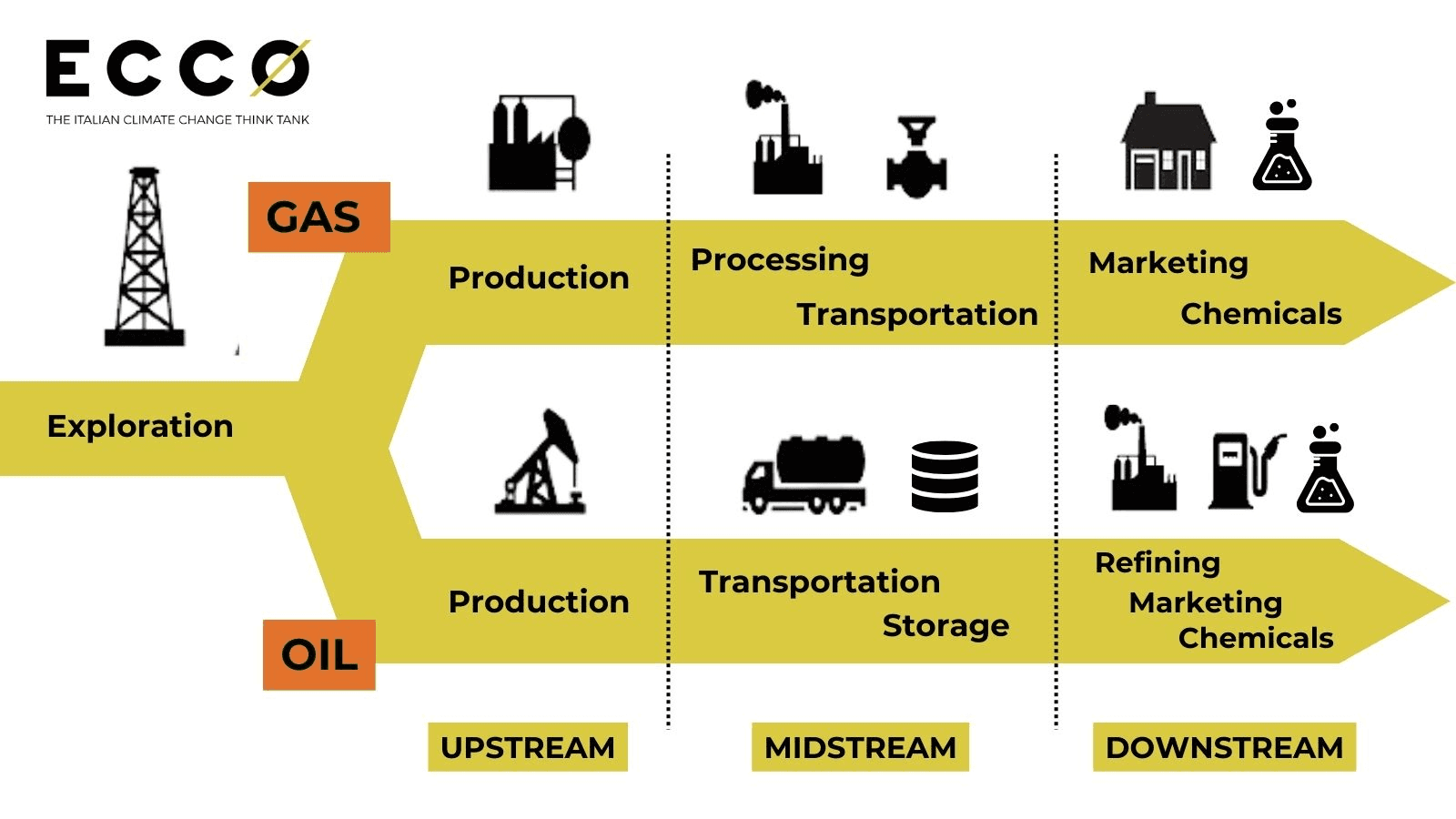
To understand how each sub-sector responds to crude price shocks, it helps to start with how each one actually makes money.
1. Upstream companies
These are the producers. They extract crude oil and natural gas from the ground and sell it at or near prevailing market prices. Their revenue is therefore almost directly indexed to the commodity price. When crude rises, upstream revenue rises almost immediately, and because the cost structure of a producing well is largely fixed in the short term, the incremental revenue flows through to earnings with significant operating leverage. This is the sub-sector with the most direct and amplified sensitivity to crude price movements, in both directions.
What this means in practice is that upstream equities behave almost like a leveraged bet on the commodity itself. During a geopolitical supply shock that sends crude sharply higher, upstream producers are typically the first equities to reprice and often the most dramatic movers. The flip side is equally true: when crude falls, upstream earnings collapse quickly, dividend coverage ratios deteriorate, and capital expenditure programs are cut. The volatility profile of upstream equities is the highest of the three sub-sectors, and that has direct implications for how they function within a broader portfolio.
2. Midstream companies
These are pipeline operators, storage facilities, and natural gas processors — occupy a structurally different position. Their business model is not built around commodity price exposure at all. Midstream operators earn revenue primarily through fee-based contracts: a shipper pays a fixed tariff per unit of volume transported through the pipeline, regardless of what that volume is worth at the other end. This is closer in character to a toll road than to a commodity business.
The practical consequence is that midstream earnings are largely insulated from crude price movements in either direction. A doubling of the oil price does not double a pipeline operator's revenue; nor does a collapse in crude prices devastate its cash flows in the way it does for a producer.
What midstream companies are sensitive to is volume , or the amount of crude oil, natural gas, and natural gas liquids actually flowing through their infrastructure. This distinction is important because volume can be affected by a crude price shock indirectly. If prices collapse far enough that producers shut in wells or reduce drilling activity, eventually less product flows through the pipes.
But the earnings impact is slower, more muted, and more predictable than it is for upstream operators. For this reason, midstream equities tend to exhibit significantly lower beta to crude prices and are often more appropriately compared to infrastructure assets than to commodity-sensitive equities.
3. Downstream companies
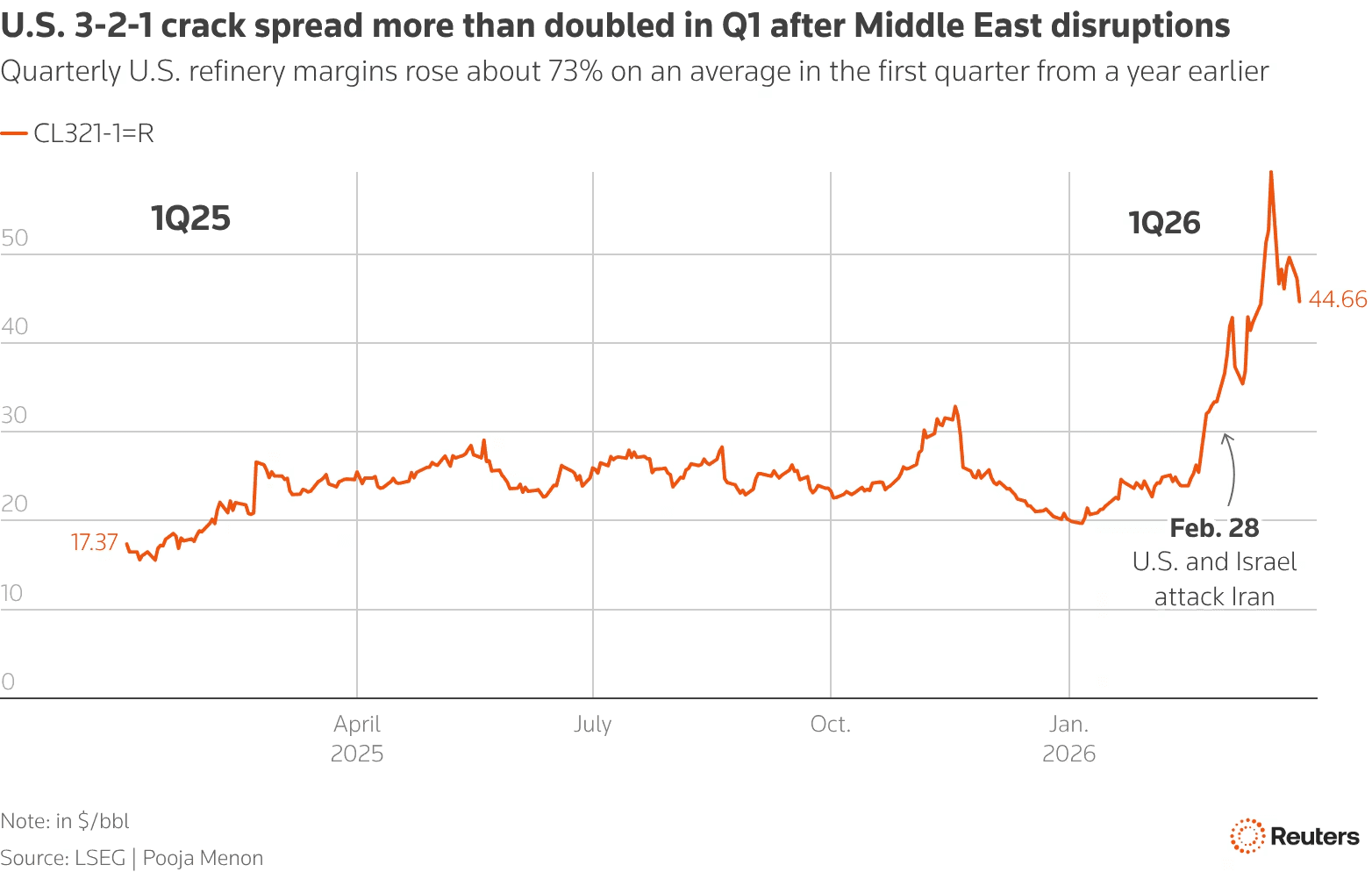
Here we have the refiners and marketers. They represent perhaps the most counterintuitive piece of the value chain from a crude price shock perspective. The simplistic view is that rising crude prices are bad for refiners because crude is their primary input cost. The reality is considerably more nuanced. Refiners do not earn a margin on crude oil itself; they earn a margin on the spread between the price of crude oil they buy and the price of refined products — gasoline, jet fuel, diesel — that they sell. This spread is known as the crack spread.
When a crude price shock occurs, the crack spread does not move in lockstep with crude. Refined product prices are driven by their own regional supply and demand dynamics, and they often lag the crude price move. In the immediate term following a crude spike, refiners can actually experience margin compression as their input costs rise faster than they can pass through price increases in refined products.
However, over a somewhat longer horizon — weeks to months — refined product prices tend to follow crude higher, and refiners with efficient operations can ultimately see margin expansion if crude price volatility creates regional supply dislocations in refined products. The earnings impact is therefore a function of both the magnitude and the duration of the crude price move, as well as the specific refined product mix of each refiner.
Practical Implications for Portfolio Construction and Client Positioning
For investment advisors, the practical takeaway from this analysis is that sub-sector composition within an energy allocation is at least as important as the size of that allocation.
A portfolio that is overweight midstream relative to upstream will carry meaningfully lower commodity beta and behave more like an infrastructure allocation with an energy label. This may be appropriate for clients who need some inflation sensitivity and yield but cannot tolerate the earnings volatility that comes with direct crude price exposure. Midstream's fee-based cash flows also tend to support more stable and predictable distributions, which has obvious relevance for income-oriented portfolios.
A portfolio tilted toward upstream producers, by contrast, functions more like a direct commodity position embedded within an equity wrapper. The operating leverage inherent in upstream businesses amplifies crude price moves into equity returns, which can be powerful during a sustained commodity upcycle but painful during corrections. Advisors who use upstream-heavy energy allocations as a portfolio hedge against inflation or geopolitical risk should be explicit with clients about this volatility profile and size the position accordingly.
Downstream exposure is best understood as a separate analytical task altogether. Refining margins are driven by regional supply dynamics, crude quality differentials, and refined product demand — variables that require dedicated analysis and are not simply a function of where crude is trading. Treating refiner equities as a crude price hedge is a category error; they are better understood as a distinct industrial business that happens to sit at the end of the oil and gas value chain.
Finally, it is worth noting that the sequencing of sub-sector responses to a crude price shock creates short-term tactical opportunities for active managers. Upstream equities tend to move first and fastest. Midstream equities are largely unaffected in the near term. Downstream equities may initially lag or even decline before recovering as crack spreads normalize. A portfolio manager who understands this sequencing can position across the value chain to manage both the directionality and the timing of energy exposure — a level of precision that a blunt sector allocation simply cannot provide.
The energy sector will always attract attention during commodity price events, but the advisors who add the most value are those who look past the sector label and ask a more precise question: which part of the value chain do I actually want to own, and why?
Put This Thesis on Autopilot with Surmount Wealth
Understanding the mechanics of upstream, midstream, and downstream energy is one thing. Systematically acting on that understanding — consistently, at scale, across your entire client book — is another challenge entirely.
This is exactly the problem that Surmount Wealth solves.
Surmount Wealth offers a powerful platform for investment advisors and portfolio managers to build, deploy, and automate rules-based trading strategies that can be customized to any investment thesis — including the kind of nuanced, sub-sector-aware energy positioning we have discussed in this article. Whether you want to implement a strategy you have already developed internally or leverage one of Surmount's prebuilt automated strategies, the platform gives you the infrastructure to move from insight to execution without the operational drag of manual implementation.
What Could This Look Like in Practice?
Consider a hypothetical strategy — call it the Energy Value Chain Rotation Strategy — built around exactly the dynamics discussed in this article. Here is how such a strategy might be constructed:
The strategy would monitor a set of macro and commodity signals: the spot price of WTI crude, the shape of the futures curve, and a measure of crack spread movement. When crude prices spike sharply — as they have during recent geopolitical disruptions — the strategy would automatically tilt the energy allocation toward upstream producers, where operating leverage to crude prices is highest and the potential for near-term price appreciation is greatest. As the crude spike matures and crack spreads begin to normalize, the strategy would rotate a portion of that exposure into downstream refiners positioned to benefit from the lag in refined product price adjustment. Throughout the cycle, a core midstream allocation would remain stable as a yield-generating, low-beta anchor.
When crude prices stabilize or the futures curve moves into contango — signaling a market expectation of oversupply — the strategy would systematically reduce upstream beta and shift back toward midstream as the portfolio's dominant energy exposure.
This is entirely hypothetical and presented purely as an illustration of the kind of structured, rules-based thinking that Surmount Wealth's platform is built to execute. But the point stands: a thesis this specific deserves an implementation infrastructure this precise.
Why Surmount Wealth?
Manual rebalancing across client portfolios based on commodity signals is operationally intensive and prone to inconsistency. Surmount Wealth eliminates that friction. The platform allows you to:
Automate any rules-based thesis — from simple sector tilts to multi-signal rotation strategies like the one described above
Deploy prebuilt strategies developed by experienced practitioners, ready to run from day one
Customize and white-label strategies to align with your firm's investment philosophy and client mandates
Scale across your entire client book without proportional increases in operational overhead
The result is that your best thinking gets implemented with discipline and consistency — every time, for every client — without you manually executing each trade.
If the energy dynamics discussed in this article are relevant to how you are positioning client portfolios right now, there has never been a better time to explore what systematic execution could do for your practice.
Book a demo with Surmount Wealth today and see how your thesis can become a strategy.


