
Blog

Core-Satellite Portfolio Strategy: Balancing Stability and Tactical Risk
Client conversations about individual stock exposure have become more frequent — and more urgent — as retail investing forums amplify narratives about "the next big winner." Advisors are increasingly asked to justify diversified allocations against the pull of concentrated, high-conviction bets. A core-satellite portfolio strategy offers a structured answer: it lets you satisfy a client's appetite for tactical positioning without compromising the long-term stability of the overall portfolio.
What Is a Core-Satellite Portfolio Strategy?
A core-satellite portfolio strategy splits a portfolio into two distinct components with different objectives, risk profiles, and management approaches. This isn't a new concept in institutional portfolio construction — it builds directly on the risk-return framework laid out in Modern Portfolio Theory, but it's gaining renewed relevance as advisors look for a defensible framework to manage client demand for individual stock exposure.
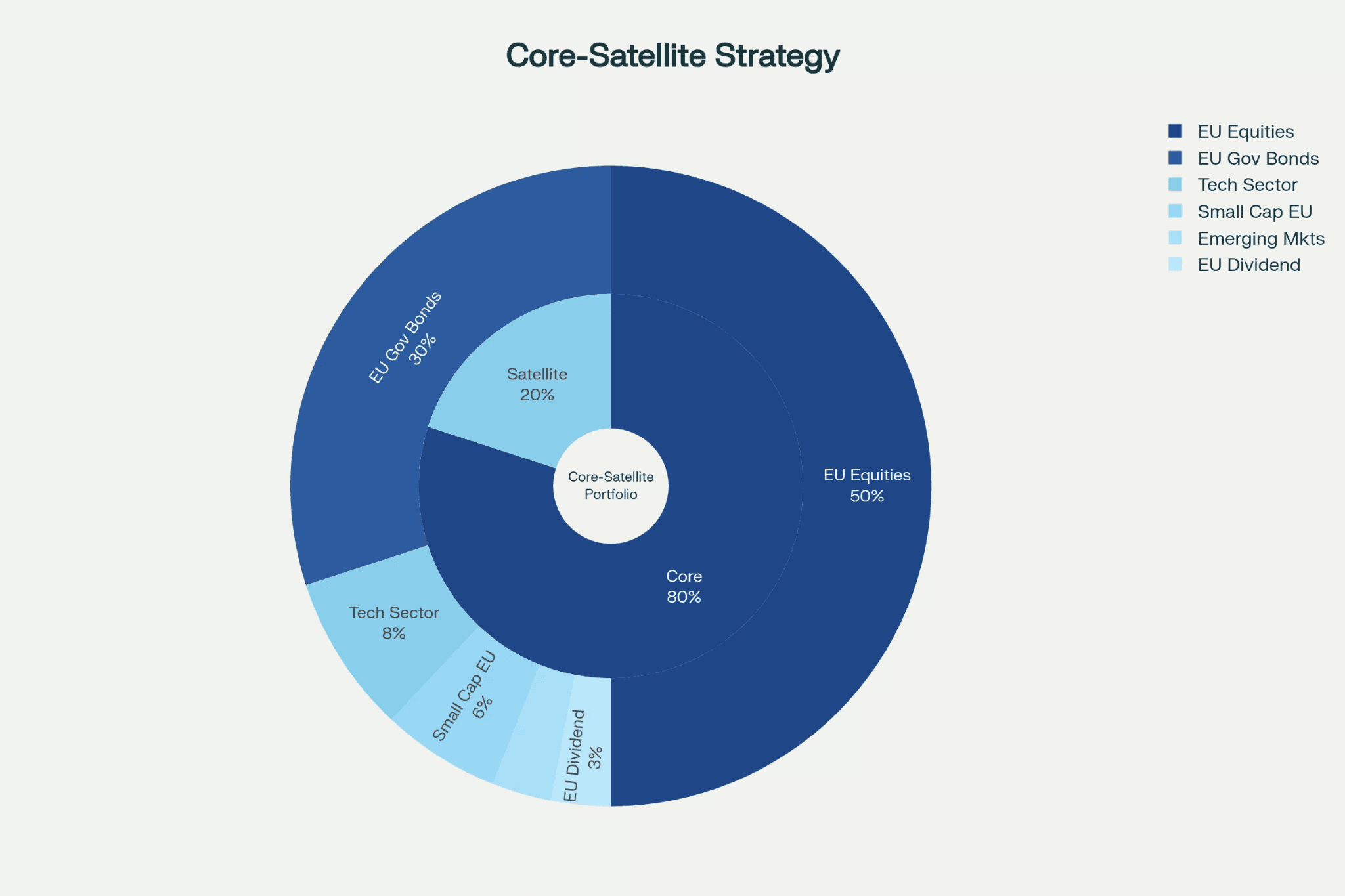
The Core: Stability Through Broad Diversification
The core is the anchor — typically 60% to 90% of total portfolio value — allocated to broadly diversified, low-cost index exposure. Its job is singular: capture market returns efficiently, with minimal turnover and minimal idiosyncratic risk. This is where core-satellite asset allocation does most of its work, since the core's composition rarely needs active intervention beyond periodic rebalancing.
The Satellite: Room for Tactical Asset Allocation
The satellite sleeve is smaller — usually 10% to 40% — and exists to accommodate tactical asset allocation: sector tilts, factor exposures, individual equity positions, or thematic bets. This is the mechanism that lets clients pursue conviction ideas in a contained, risk-aware way, rather than letting those ideas creep into the core allocation where they can distort overall portfolio risk.
How Much Should Be in Core vs. Satellite?
There's no universal answer, but the split should be a function of client risk tolerance, time horizon, and the advisor's confidence in monitoring the satellite sleeve actively.
Common Allocation Ranges by Risk Tolerance
Conservative clients: 85–90% core, 10–15% satellite — satellite positions limited to modest sector tilts rather than single-name concentration.
Moderate clients: 70–80% core, 20–30% satellite — room for a handful of individual positions alongside tactical sector exposure.
Aggressive clients: 60–70% core, 30–40% satellite — meaningfully larger conviction sleeve, but still bounded relative to an unconstrained, fully self-directed account.
The key discipline, regardless of the split, is treating the satellite allocation as a defined, monitored sleeve — not an open-ended exception to the portfolio's risk framework.
Concentration Risk Management Within the Satellite Sleeve
Even a well-sized satellite allocation can undermine the portfolio if it isn't actively monitored. Effective concentration risk management within the satellite sleeve typically requires:
Position sizing limits — capping any single name or theme at a fixed percentage of total portfolio value
Correlation checks — ensuring satellite positions don't unintentionally duplicate core exposure, a growing concern given current index-level concentration in a handful of mega-cap names
Drawdown triggers — predefined thresholds that prompt a review or reduction of a position rather than an ad hoc decision made under stress
Periodic rebalancing — bringing the satellite sleeve back to its target weight as tactical positions appreciate or decline
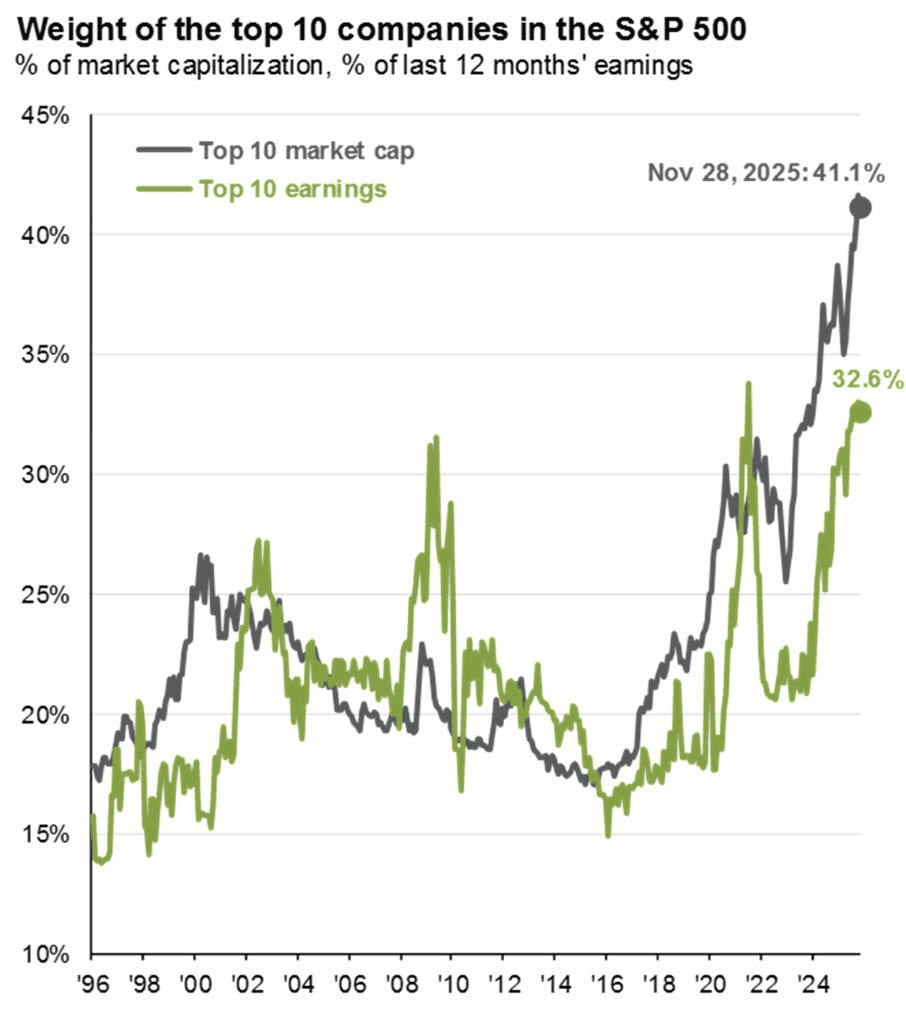
Without these guardrails, a satellite sleeve can drift into the same uncompensated, single-name risk that core-satellite investing is designed to avoid — a dynamic we've walked through in detail when addressing tech overconcentration in client portfolios.
Why Rules-Based Portfolio Construction Supports the Core-Satellite Approach
Manually enforcing position limits, correlation checks, and rebalancing triggers across dozens or hundreds of client accounts is operationally demanding. This is where rules-based portfolio construction becomes less of a theoretical nicety and more of a practical necessity. Codifying the satellite sleeve's constraints into a defined ruleset — rather than relying on manual review — reduces the risk of inconsistent application across a book of clients, reinforcing why disciplined rebalancing outperforms forecast-driven timing over a full cycle, and removes the behavioral drift that can creep into discretionary satellite management.
The Role of Automated Portfolio Rebalancing in Core-Satellite Investing
Automated portfolio rebalancing is where a core-satellite portfolio strategy moves from framework to functioning system. As satellite positions appreciate or underperform, automated rebalancing keeps the sleeve within its intended weight range without requiring an advisor to manually track and execute trades across every account — see our breakdown of how rebalancing frequency affects outcomes for the underlying mechanics. For a satellite portfolio strategy to hold up over time — especially across a growing client base — automation isn't a convenience; it's what makes the discipline scalable.
Conclusion
A core-satellite portfolio strategy gives advisors a structured way to say "yes" to client conviction without exposing the broader portfolio to unnecessary concentration risk. The framework is well established, but its effectiveness depends entirely on disciplined execution: sized positions, defined triggers, and consistent rebalancing — the same behavioral discipline we cover in our framework for advisors managing client pressure driven by recency bias. For advisors managing this across multiple client accounts, the operational question quickly becomes less about the strategy itself and more about how to enforce it reliably at scale.
Automate This Strategy with Surmount Wealth
Reading about a core-satellite portfolio strategy is one thing. Enforcing it consistently — across every client account, every rebalancing cycle, every position limit — is another challenge entirely. This is exactly the operational gap Surmount Wealth's automation infrastructure is built to close.
Surmount Wealth lets you apply rules-based, systematic execution directly on top of your existing brokerage accounts — no fund transfers, no custom code required. Whether you're working from one of Surmount's prebuilt strategy templates or building a fully custom ruleset, the mechanics discussed in this post (position sizing limits, correlation checks, drawdown triggers, periodic rebalancing) can be codified once and applied automatically across your entire book of clients.
What this looks like in practice:
Prebuilt strategy library — access professionally designed, rules-based strategies covering diversified core exposure, tactical tilts, and risk-managed satellite approaches, ready to deploy without building from scratch
Custom strategy builder — translate your own core-satellite framework, including specific allocation ranges and rebalancing triggers, into an automated ruleset tailored to your practice
Consistent enforcement — apply the same position limits and rebalancing discipline across every client account, removing the manual review burden and reducing behavioral drift
No asset transfer required — strategies execute directly on your clients' existing brokerage accounts, so onboarding doesn't disrupt custodial relationships
Scalable oversight — monitor satellite sleeve performance and concentration risk across your full client base from a single interface
A Hypothetical Illustration
Hypothetical example, for illustrative purposes only — not an actual strategy performance result, backtested return, or investment recommendation.
Consider a hypothetical rules-based satellite sleeve designed around the concentration guardrails discussed above — for example, a strategy that caps any single position at a fixed percentage of the satellite allocation, automatically trims positions that breach a predefined drawdown threshold, and rebalances the sleeve back to target weight on a set schedule. A framework like this could, in principle, be built and automated on Surmount Wealth without manual intervention — turning the discipline described in this post into a system rather than a standing manual task.
This is a hypothetical strategy concept for illustrative purposes only and does not constitute investment advice or a recommendation to buy or sell any security. Any strategy deployed on the Surmount Wealth platform should be independently evaluated and back-tested against your firm's investment policy and suitability requirements.
Why Advisors Are Automating Theses Like This on Surmount:
No manual monitoring — rules execute consistently, without emotional drift
Full auditability — every trigger and trade is logged and defensible to clients and compliance
No infrastructure build — deploy on existing brokerage accounts, no fund transfers required
Backtestable logic — validate a thesis against historical data before committing capital
Scalable across books — apply the same systematized logic across every client account that fits the mandate
If you're managing core-satellite allocations — or any rules-based thesis — across client accounts and want to see how automation could reduce that operational load, book a demo with Surmount Wealth today and see how much of this can run on its own.
FAQ: Core-Satellite Portfolio Strategy
What is a core-satellite strategy?
It splits a portfolio into a diversified core and a smaller, tactical satellite sleeve for individual positions or tilts.
How much goes in core vs satellite?
Typical splits range from 60–90% core and 10–40% satellite, depending on client risk tolerance.
Why use a satellite portfolio strategy?
It lets clients pursue tactical asset allocation and conviction ideas without destabilizing the core allocation.
Does core-satellite reduce concentration risk?
Yes — position limits, correlation checks, and rebalancing within the satellite sleeve manage concentration risk directly.
Can core-satellite investing be automated?
Yes — rules-based portfolio construction and automated portfolio rebalancing let advisors enforce the strategy consistently at scale.