
Blog

AI Job Displacement Market Risk: What’s Priced In?
The Acceleration Nobody Modeled
For years, AI-driven workforce reduction lived in the forecast. In 2026, it moved into the earnings call.
Major technology companies have announced cumulative workforce reductions totaling tens of thousands of roles this year alone, with AI cited as the primary driver in nearly every case. These are not restructurings buried in footnotes. They are headline-level events at some of the most widely held companies in institutional portfolios.
The pace is notable. A recent survey of corporate executives found near-unanimous agreement that AI-related layoffs will occur at their organizations within the next two years. What was once a theoretical displacement curve is now a capital allocation decision being executed in real time.
White-Collar Layoffs Are No Longer a Forecast
The current wave is concentrated in white-collar, knowledge-based roles — the same job categories that historically buffered workers from automation. Entry-level positions in technology, content, customer operations, and back-office functions are being eliminated at scale.
This matters for advisors not just as a social trend, but as a structural input. When displacement hits professional-class workers, it compresses the income base that drives discretionary spending, housing demand, and long-term savings behavior — all variables that flow directly into equity fundamentals. BofA Global Research projects that nearly a quarter of global jobs could eventually be disrupted by AI deployment, with the highest concentration in high-income countries.
Why This Cycle Feels Different From Past Automation Waves
Previous automation waves displaced physical labor and created new categories of knowledge work in parallel. The current wave is different: it is targeting knowledge work directly, and the replacement jobs being created — largely in construction and data center buildout — are temporary by nature. Once infrastructure is built, it runs on a fraction of the workforce that constructed it.
That asymmetry is not yet fully reflected in consensus growth models.
Consumer Spending and Equity Markets: The Disconnect
Consumers account for roughly 70% of U.S. economic activity. That single data point reframes every labor market development as a potential market risk event.
Record Highs, Record-Low Sentiment — Reading the Divergence
Equity indexes are currently trading near all-time highs. Consumer sentiment, by contrast, is at its lowest recorded level since tracking began in 1952, according to University of Michigan Consumer Sentiment data via FRED. That divergence is historically anomalous. In prior bull markets — including the late 1990s — equity highs and sentiment highs moved together.
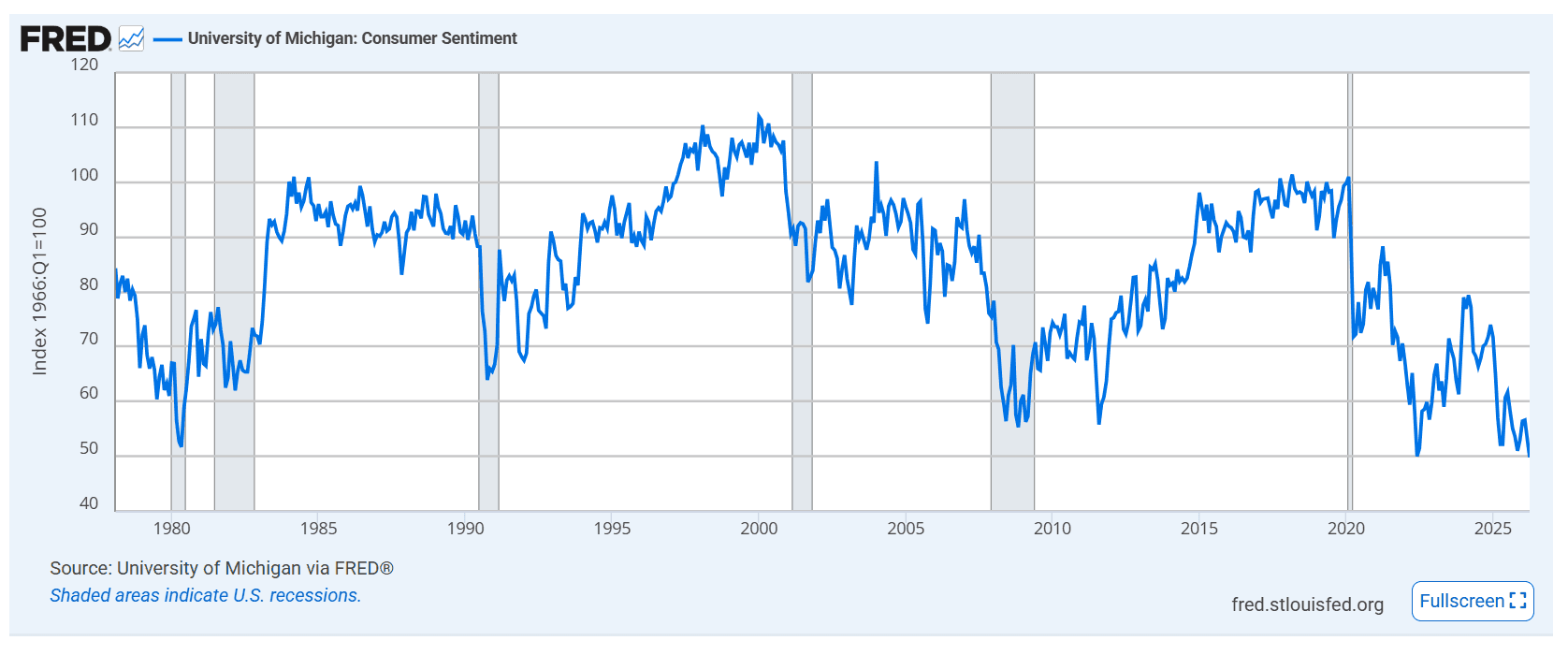
The current decoupling suggests that either markets are pricing in a recovery that consumers cannot yet feel, or valuations have detached from the consumption engine that underlies them — a read consistent with several leading recession indicators that have been flashing amber for successive quarters. For portfolio managers, that is not a comfortable ambiguity to carry at current multiple levels. The relationship between consumer spending and equity markets has rarely been this strained without a subsequent repricing.
Tech Sector Layoffs 2026 and the CapEx Paradox
When Cost-Cutting Funds the Same Tech Replacing the Workers
There is a structural irony embedded in tech sector layoffs in 2026. The largest technology companies are simultaneously reducing headcount and announcing record capital expenditure budgets — in several cases, the workforce reductions are explicitly framed as a mechanism to fund AI infrastructure investment.
The five largest hyperscalers are projected to spend close to $700 billion in capital expenditure this year, an increase of over 80% versus 2025, according to reporting by the Financial Times. That spending has materially compressed free cash flow at several of these companies, with some projecting significantly negative free cash flow for the full year.
For equity analysts, negative free cash flow at this scale — funded increasingly by debt issuance and, in at least one case, equity issuance — raises legitimate questions about capital discipline and return timelines, a dynamic we examined in depth when credit markets began diverging from the tech rally. AI job displacement market risk is not isolated to labor markets. It is embedded in the valuation assumptions of the companies driving the displacement.
Stagflation Portfolio Strategy in a Displacement-Driven Economy
The macro backdrop compounds the labor market picture. For advisors building a stagflation portfolio strategy, the confluence of inflation pressure, supply disruption, and slowing employment creates a regime that demands more than incremental rebalancing. The effective closure of a critical global shipping corridor for over three months has triggered an inflation surge layered on top of already tepid job growth. The combination — rising prices, slowing employment, and weakening consumer confidence — maps onto a stagflationary regime.
Stagflation is historically one of the most hostile environments for equity markets, a pattern well documented in NBER research on the 1970s inflationary cycle. It erodes real earnings, compresses multiples, and removes the Fed’s ability to respond with straightforward rate cuts without worsening inflation.
Big Tech Free Cash Flow and What It Signals for Valuations
A stagflation portfolio strategy typically rotates toward real assets, short-duration instruments, and sectors with genuine pricing power — particularly relevant now that the equity risk premium across large-cap technology has compressed to near zero. The challenge in 2026 is that the most concentrated positions in institutional portfolios sit in precisely the segment — large-cap technology — where free cash flow is deteriorating and debt is rising. That concentration creates a rebalancing problem that cannot be solved incrementally.
Market Concentration Risk and the AI Boom Parallel
Market concentration risk today mirrors levels recorded just before the unwinding of the dot-com boom, a structural condition we have previously documented across valuation metrics and capital flow data in our analysis of the S&P 500 concentration bubble. Cyclically adjusted valuations, as measured by the Shiller CAPE ratio, remain at levels historically associated with periods of subsequent underperformance.
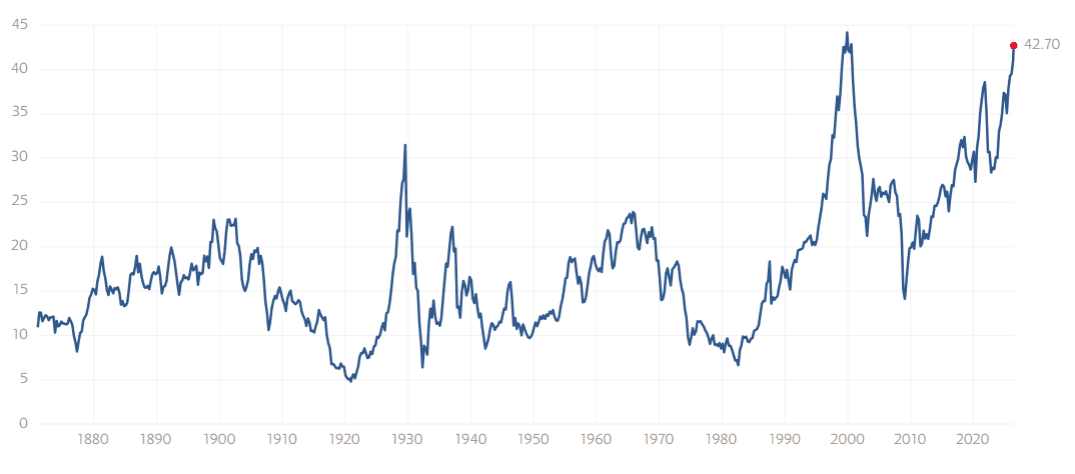
The macro backdrop, however, is notably weaker. The late 1990s saw annual job creation approaching three million. In 2025, the figure was 181,000.
That context matters when evaluating AI job displacement market risk at the portfolio level. The AI boom has driven remarkable returns. It has also produced a concentration of risk that leaves little margin for error if the macro environment continues to deteriorate.
Conclusion
AI-driven workforce reduction is no longer a tail risk. It is an active variable in consumer spending, sentiment, and the free cash flow profiles of the most widely held equities in institutional portfolios. Advisors who are still treating this as a background theme rather than a front-book risk factor may find the repricing moves faster than their rebalancing process.
The question is not whether AI job displacement carries market risk. It does. The question is whether your current positioning reflects that.
Automate Your Macro Thesis With Surmount Wealth
The dynamics covered in this piece — deteriorating free cash flow, consumer spending pressure, sector rotation into stagflation-resistant assets — are exactly the kind of macro thesis that Surmount Wealth’s automated strategy infrastructure is built to act on.
Surmount allows portfolio managers and investment advisors to build, test, and automate strategies that respond systematically to shifting macro conditions, without requiring you to write code or transfer client assets.
Consider a hypothetical strategy: a Stagflation Rotation Model that systematically reduces exposure to high-multiple, negative-free-cash-flow technology names while rotating into short-duration fixed income, real asset ETFs, and recession-resistant equities — rebalancing automatically as macro signals evolve. That kind of disciplined, rules-based execution is exactly what Surmount’s platform is designed to support.
This is a hypothetical strategy concept for illustrative purposes only and does not constitute investment advice.
Surmount also offers a growing library of prebuilt automated strategies — from defensive equity rotators to thematic sector plays — that advisors can deploy directly or customize to fit their specific thesis.
If the macro picture is shifting, your execution infrastructure should be able to shift with it. Book a demo with Surmount Wealth today.
FAQ: AI Job Displacement Market Risk
How does AI displacement affect equity markets?
Mass AI-driven layoffs compress consumer income and spending power, weakening the revenue base that underpins equity valuations — particularly in consumer-facing sectors.
What is AI job displacement market risk?
It is the portfolio risk created when AI-driven workforce reduction suppresses consumer spending, deteriorates corporate fundamentals, and pressures equity multiples at scale.
Which sectors face the most displacement risk?
High-multiple technology companies with negative free cash flow and consumer discretionary sectors carry the most direct exposure in the current AI-driven layoff cycle.
Is stagflation a real concern in 2026?
Rising inflation from supply disruptions, combined with slowing job growth and record-low consumer sentiment, presents a credible stagflationary setup that portfolios should be stress-tested against.
How should advisors position for this risk?
A stagflation portfolio strategy favoring real assets, short-duration instruments, and sectors with durable pricing power offers a more resilient posture than concentrated big tech free cash flow exposure.
Related


Get Started
Experience the full power of our SaaS platform with a risk-free trial. Join countless businesses who have already transformed their operations. No credit card required.
FAQs
How can this impact my business?
How long does an this take to implement?
Will we need to make changes in our teams?

Still have a question?
Get in touch with our team.