
Blog

Fed Forward Guidance Is Gone: Rebuild Your Portfolio
For decades, the Federal Reserve operated like a co-pilot for financial markets — signaling turns in advance, telegraphing rate moves, and managing investor expectations with carefully chosen language. That era appears to be over.
At the June 2025 FOMC meeting, new Fed Chair Kevin Warsh delivered a striking message: don't expect us to hold your hand anymore. The statement was shorter. The easing bias was removed. When pressed on future rate guidance, Warsh flatly refused to provide it — repeatedly. For portfolio managers and investment advisors, this is not a communication quirk. It is a structural shift that changes how risk must be priced, how portfolios must be built, and how clients must be advised.
Understanding what the end of Fed forward guidance means — and responding to it systematically — is now a core competency for professional allocators.
Why the Fed Abandoned Forward Guidance
The Fed's communication model has been dismantled deliberately, not accidentally. Two clear signals confirm this.
Warsh's Communication Regime Shift
Under the prior regime, every Fed statement was parsed word by word. Each adjective carried weight. Markets priced rate moves months in advance because the Fed essentially told them to. That communication model gave investors a framework — a Fed reaction function they could model, back-test, and trade around.
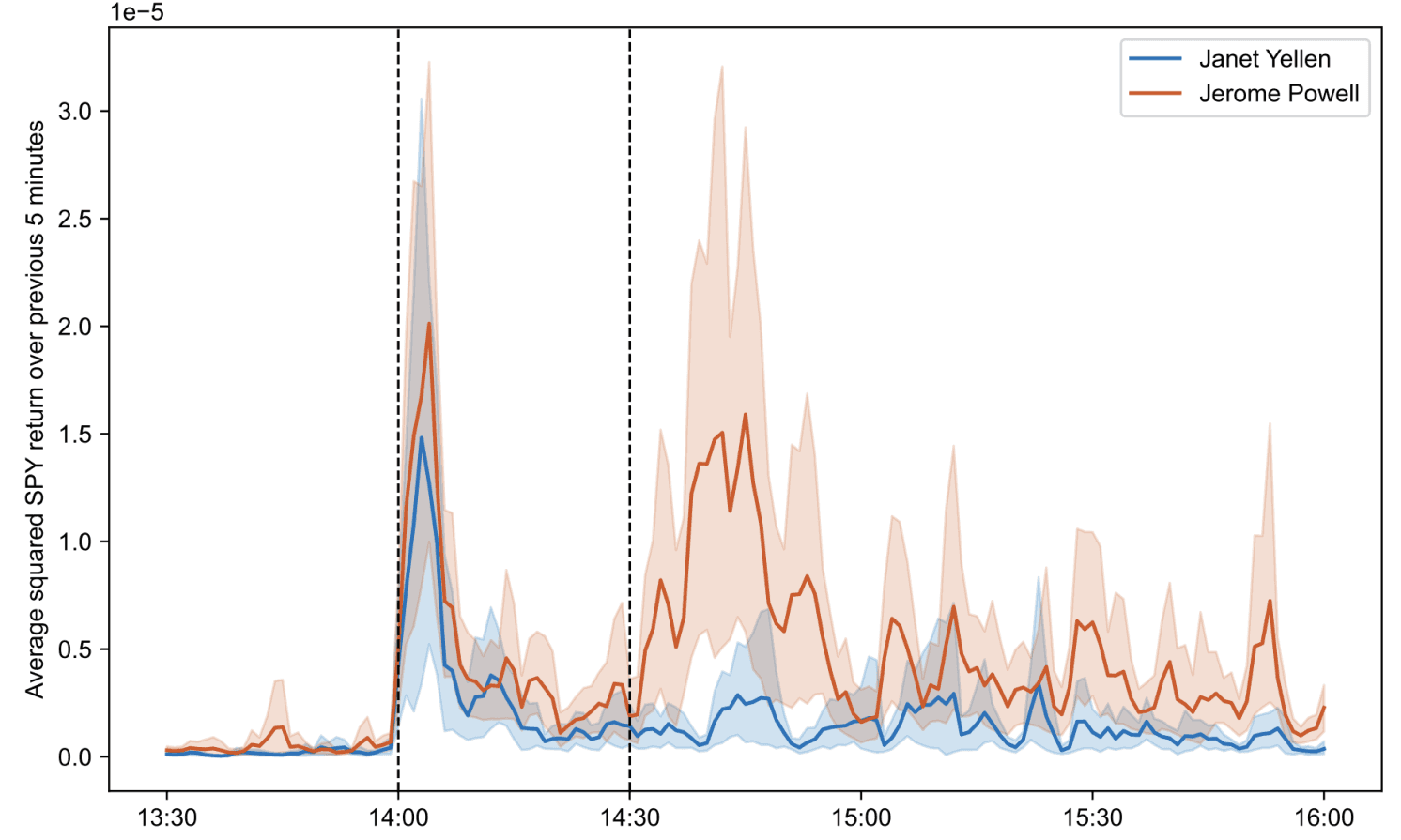
Warsh has explicitly rejected that approach. At the June press conference, he declined to answer questions about future rate projections, refused to confirm the Fed's next move, and pushed back on journalists who tried to extract the kind of forward guidance markets had come to expect. He also announced five internal task forces — covering communication, balance sheet use, data methodology, productivity, and policy framework — signaling that the institution itself is under review, not just the rate path.
This appears to be an intentional redesign of how the Fed relates to markets.
What the Shorter, Colder Fed Statement Signals
The language shift in the June statement deserves its own analysis. The easing bias — the implicit acknowledgment that cuts were the next probable move — was removed entirely. The statement was shorter, less nuanced, and more focused exclusively on price stability.
Combined with a dot plot that now shows nine committee members expecting at least one rate increase before year-end, and a 2026 headline PCE forecast revised up from 2.7% to 3.6%, the Fed's message is clear: the Fed dot plot strategy has moved from "when do we cut?" to "should we raise again?" The market has not fully priced this shift.
What Losing Fed Forward Guidance Means for Markets
When the Fed stops guiding, uncertainty increases. And uncertainty has a direct cost.
The Risk Premium Problem for Equities
Markets price assets relative to a risk-free rate plus a premium for uncertainty. When the Fed provided clear guidance, investors could compress that uncertainty premium — forward rates were anchored, and equity multiples expanded accordingly. With Fed forward guidance removed, the uncertainty component of the risk premium widens.
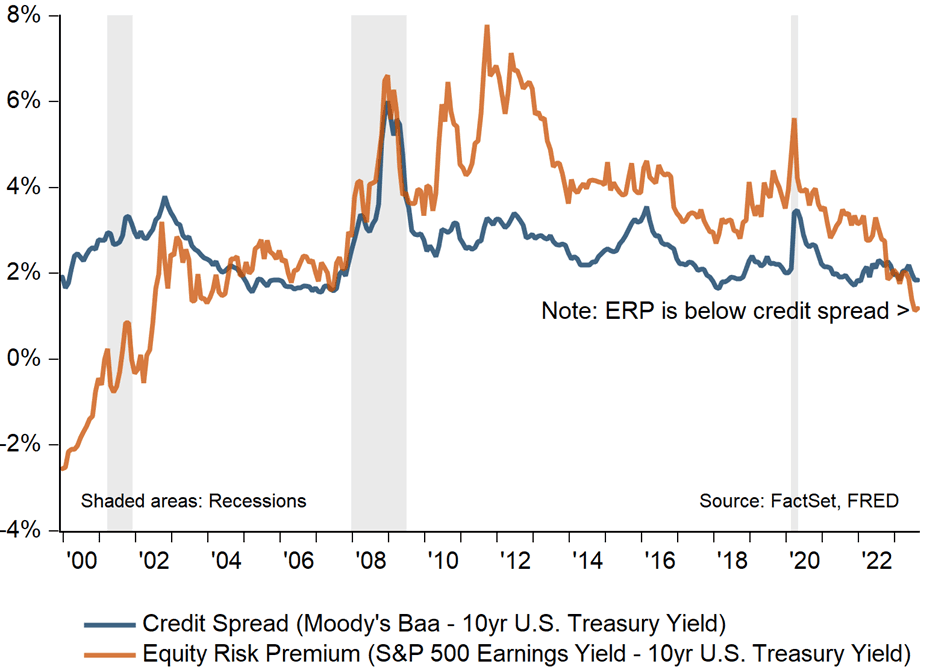
This is the mechanism behind risk premium equities re-pricing. It is not about whether the economy is growing or contracting. It is about the cost of not knowing what the central bank will do next. Expensive long-duration equities — particularly those priced on earnings weighted far into the future — are the most exposed. As we explored in our analysis of equal-weight vs. cap-weight index dynamics, the concentration of market cap in rate-sensitive growth names makes the aggregate index more vulnerable to this repricing than headline valuations suggest.
Duration Risk in a Policy Vacuum
The bond market faces a parallel problem. Without clear guidance on the rate path, the front end of the yield curve becomes unstable — and volatility at the front end propagates across all maturities. Duration risk portfolio management becomes substantially harder when the Fed has explicitly declined to anchor expectations.
The 30-year Treasury has already been signaling stress, as we detailed in our breakdown of what the long end is telling allocators in 2026. Meanwhile, global liquidity pressures from rising bond yields in Asia are adding a further layer of duration stress that domestic rate models alone do not capture. The removal of Fed forward guidance adds a new layer of uncertainty on top of already-elevated long-end yields — compressing the utility of traditional fixed income as a portfolio stabilizer.
Portfolio Construction Strategies for an Unguided Fed
If the Fed will no longer anchor expectations, portfolios must anchor themselves.
Repositioning Fixed Income Without a Fed Anchor
The classic approach to interest rate uncertainty portfolio construction — extending duration when cuts were anticipated — is no longer appropriate. With the rate path genuinely unknown, duration extension introduces uncompensated risk. The more defensible posture for most allocators involves:
Shortening duration across fixed income allocations to reduce sensitivity to rate path volatility
Increasing exposure to floating rate instruments that reprice automatically as the short end moves
Prioritizing quality over yield — in a high-uncertainty environment, credit spreads can widen quickly on policy surprises
Reducing reliance on bonds as an equity hedge — the stock-bond correlation breakdown observed in 2022 is more likely to persist in an environment of monetary policy uncertainty
The hawkish Fed portfolio positioning playbook from 2022 is a reasonable starting reference, but the current regime adds an additional variable: communication opacity. Rate hikes in 2022 were well-telegraphed. Rate moves in 2025–2026 may not be.
Systematic Rebalancing as a Substitute for Policy Clarity
When the Fed provided forward guidance, advisors could build positioning around an anticipated rate path. That anchor is gone. The most practical substitute is rules-based, systematic portfolio rebalancing — pre-defined rebalancing triggers that respond to market signals rather than Fed signals.
This approach has a strong evidence base — as we outlined in our piece on recession indicators and systematic execution, disciplined rebalancing consistently outperforms discretionary market timing across macro regimes, including periods of policy uncertainty. The case for reducing discretionary overrides in favor of pre-defined rules is well established — and as we argued in The Hidden Cost of Advisor Optionality, more decision points rarely produce better client outcomes.
Fixed income strategy 2025 must reflect this reality. Advisors who adapt their construction frameworks now — before the next unexpected rate signal lands — will be better positioned than those waiting for clarity that may not come.
Conclusion
The removal of Fed forward guidance is not a temporary communication experiment. It is the opening move of a broader institutional transformation. For advisors and portfolio managers, this changes the investment environment in ways that are structural, not cyclical.
Portfolios built on the assumption of a cooperative, transparent central bank are now exposed. The cost of capital is higher when uncertainty is wider. Long-duration assets are more vulnerable. Fixed income offers less reliable hedging. And discretionary positioning around an anticipated Fed path is no longer a viable strategy.
The advisors best positioned for what comes next are those who replace Fed dependency with rules-based frameworks — strategies that respond to signals, not stories.
Automate Your Fed Thesis With Surmount Wealth
Reading the macro environment is one thing. Executing on it — consistently, without hesitation, across every client portfolio — is another challenge entirely.
Surmount Wealth is an AI-driven investment platform that allows professional advisors and portfolio managers to build, backtest, and fully automate rule-based strategies directly on top of existing brokerage accounts. No fund transfers. No coding. Just professional-grade strategy infrastructure applied systematically.
Consider a hypothetical strategy built around the dynamics discussed in this post — call it the "Guidance Vacuum Rotation Model" (illustrative concept only — not a live strategy or investment advice). This rules-based framework would:
Monitor yield curve volatility at the front end as a proxy for policy uncertainty
Automatically rotate out of long-duration growth equities when volatility breaches a defined threshold, into short-duration value and quality factor exposure
Shift fixed income allocation from intermediate to short duration when the Fed funds futures market implies elevated dispersion in rate outcomes
Reverse rotations systematically when volatility compresses and the yield curve stabilizes
Execute without discretionary override — removing the behavioral drift that undermines manual implementation
This is exactly what Surmount's platform is built to support. Whether you want to implement a strategy like this, adapt one from Surmount's prebuilt library, or build something fully custom around your own macro view — the infrastructure is already there.
Stop letting your best macro analysis sit idle. Book a demo today.
➤ Book Your Demo with Surmount Wealth Now
FAQ: Fed Forward Guidance
What is Fed forward guidance?
Fed forward guidance is the central bank's practice of communicating its future policy intentions to markets — managing expectations through statements, projections, and press conferences.
Why did the Fed stop forward guidance?
Chair Warsh has signaled a preference for fewer commitments and more retained optionality, prioritizing price stability over market management and reducing the Fed's role as a market anchor.
How does monetary policy uncertainty affect portfolios?
Monetary policy uncertainty widens the risk premium investors demand to hold equities, raises the effective cost of capital, and undermines the reliability of bonds as a portfolio hedge.
What is the best fixed income strategy now?
In a high-uncertainty rate environment, shortening duration, increasing floating rate exposure, and prioritizing credit quality over yield are the most defensible adjustments for fixed income allocations.
How should advisors respond to a hawkish Fed?
Advisors should shift toward systematic, rules-based rebalancing frameworks that respond to market signals — reducing reliance on anticipated Fed moves and building portfolios that perform across multiple rate scenarios.