Weight-Loss Drugs and Consumer Spending: A Stress Test

Weight-Loss Drugs and Consumer Spending: A Stress Test
Consumer staples have long served as the ballast in defensive equity sleeves, often anchoring the stable core of a core-satellite portfolio strategy. The working assumption is simple: households keep buying food, beverages, and essentials regardless of the cycle. GLP-1 medications are now testing that assumption at the household level. For advisors and portfolio managers, the link between weight-loss drugs and consumer spending is no longer just a healthcare story, even as demographic forces keep reshaping healthcare demand. It is a demand-durability question that belongs in the risk review.
This piece outlines a framework to:
Gauge how quickly the shift is spreading
Map which staples categories carry the most exposure
Stress-test defensive sleeves without making a sector call
Why Weight-Loss Drugs and Consumer Spending Matter for Defensive Stocks
Defensive stocks earn their label from low earnings volatility, not from immunity to structural change. A demand shift that is slow, persistent, and concentrated in specific categories is exactly the kind of risk that beta-based screens tend to miss.
What the GLP-1 Adoption Rate Signals
The GLP-1 adoption rate has climbed quickly. KFF's May 2024 Health Tracking Poll found that 6% of US adults were currently taking a GLP-1 drug. By KFF's late-2025 poll, that share had reached 12%, or roughly one in eight adults.
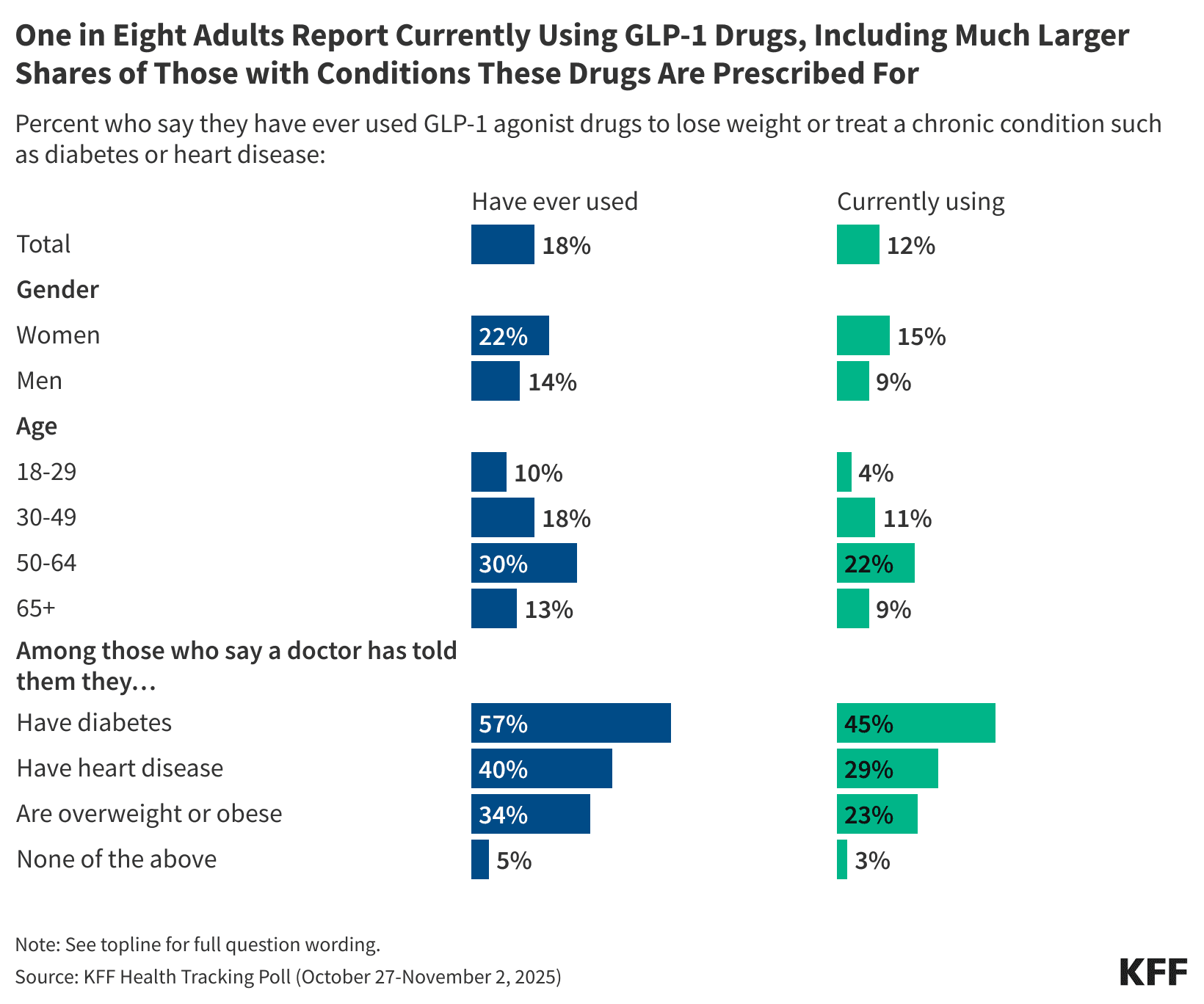
Two caveats keep the picture balanced:
Cost remains a barrier. In the same poll, 56% of users said the drugs were difficult to afford.
Policy can cut both ways. Changes to pricing and insurance coverage could accelerate or slow adoption.
From Prescription to Purchase Behavior
The most rigorous evidence so far comes from Cornell researchers who linked survey responses to household transaction data. Their study was published in the Journal of Marketing Research. Key findings:
Grocery spending fell 5.3% on average within six months of adoption.
Higher-income households cut grocery spending by more than 8%.
Savory snack spending dropped about 10%, with similar declines in sweets, baked goods, and cookies.
About one-third of users stopped the medication during the study, and their food spending reverted toward pre-adoption levels.
That last point matters. How weight-loss drugs and consumer spending interact depends heavily on whether people stay on the medication. That makes persistence a variable to monitor, not a fixed input.
Mapping Exposure Across the Consumer Staples Sector
The consumer staples sector is not uniformly exposed. Treating it as a single block can overstate risk in some holdings and understate it in others.
Packaged Food Demand: The Most Exposed Segment

Packaged food demand sits closest to the categories where the Cornell data shows the steepest declines. Calorie-dense, processed products such as chips, cookies, sweet baked goods, and confectionery face the most direct volume pressure.
Companies in these segments may have offsetting levers, including:
Pricing and mix management
Portion and package redesign
Expansion into protein-forward or better-for-you categories
Each of these levers takes time and carries execution risk.
Beverages, Restaurants, and Less-Exposed Categories
Exposure tapers across other segments:
Sugar-sweetened beverages: Their overlap with calorie-dense categories suggests elevated sensitivity, though category-level evidence is still developing.
Restaurants: The Cornell study also documents lower food-away-from-home spending, so restaurant exposure deserves its own line in the review.
Household and personal care: These products have little direct link to appetite, which points to lower expected sensitivity.
Yogurt, fresh fruit, nutrition bars, and meat snacks: These were among the few categories where the study found spending increases.
Portfolio Stress Testing for a Structural Demand Shift
Portfolio stress testing usually focuses on rate shocks, recessions, liquidity events, or commodity scenarios such as stress-testing client portfolios for an oil price shock. Applied to weight-loss drugs and consumer spending, it needs a different design: slow-moving, category-specific, and dependent on how long adoption persists.
Building a Three-Tier Scenario Analysis
A simple scenario analysis can bracket the range of outcomes. The tiers below are illustrative assumptions, not forecasts:
Plateau: Adoption stabilizes near current levels as cost and discontinuation offset new users. Volume pressure stays confined to the most exposed categories.
Steady expansion: Broader coverage and lower prices lift adoption gradually. Exposed categories face persistent volume drag that pricing alone may not offset.
Accelerated adoption: New formulations or major coverage changes broaden use significantly. Volume declines spread into adjacent categories and restaurant traffic.
For each tier, map the defensive sleeve's holdings by category exposure, estimate revenue sensitivity, and compare the results with current valuation assumptions.
Monitoring Staples Earnings Revisions
Scenarios set the boundaries, and incoming data shows which one is unfolding. Staples earnings revisions are among the earliest observable signals, because analysts tend to adjust volume estimates before reported margins reflect the change.
Useful indicators include:
Revision breadth: the share of estimates moving down versus up for exposed holdings
Volume versus price/mix: whether reported growth relies on price increases while volumes shrink, a classic earnings quality warning sign
Adoption updates: new survey or prescription data that shifts the base-case tier
What This Means for Defensive Allocation Reviews
None of this implies that staples have lost their role in portfolios. It does suggest that a defensive allocation built on historical volatility alone may embed assumptions worth re-examining, much like a structured laggard review process does for underperforming holdings.
Questions advisors can bring to the next review:
Which holdings derive the largest share of revenue from high-exposure categories?
Would the sleeve's correlation profile still hold if volume growth turned structurally negative?
Are review triggers, such as systematic sell signals, in place, or does reassessment depend on someone noticing?
Conclusion
The relationship between weight-loss drugs and consumer spending is still developing, and the evidence carries real caveats around cost, discontinuation, and policy. That uncertainty argues for structure rather than prediction. A tiered scenario framework, category-level exposure mapping, and rules-based monitoring let advisors track the shift as data arrives, rather than reacting once it appears in reported results.
Turn Your Stress-Test Rules Into Automated Workflows
A framework only helps if it runs consistently, and manual reviews tend to slip when markets get busy. Surmount Wealth lets advisors and portfolio managers turn a thesis like this one into a rules-based strategy that runs on existing brokerage accounts. You can start from a prebuilt strategy or write your own logic, with no coding required.
Hypothetical illustration: the "Demand Shift Sentinel"
Here is one idea for how the framework above could be automated:
Tag holdings in a defensive sleeve by category exposure tier (high, moderate, low).
Track revision breadth and volume-versus-price signals on a set schedule.
Flag or rebalance toward user-defined exposure bands when preset thresholds are crossed.
Log every rule trigger to support documentation and client reporting.
Important: The Demand Shift Sentinel is a hypothetical concept, shown for illustration only. It is not an existing Surmount Wealth product, has not been backtested, and has not been used with client assets. No performance is shown, implied, or should be inferred. All signals, thresholds, and exposure tiers would be defined by the user. Any automated approach carries risks, including data errors, model limitations, and the possibility that signals do not anticipate actual market outcomes.
Why advisors explore Surmount Wealth:
No asset transfers. Strategies connect to existing brokerage accounts.
Prebuilt or custom. Choose from a strategy library or build rules around your own thesis.
No code required. Build, test, and automate rules through the platform.
Test before you automate. Evaluate rule logic with backtesting tools before switching it on.
Consistent, documented execution. Rules run the same way every time, with a clear audit trail.
Every thesis your team discusses in a review could become a rule that runs on its own. Book a demo to see how your own framework could be automated.
This content is for informational and educational purposes only and does not constitute investment advice or a recommendation regarding any security, sector, or strategy.
FAQ: Weight-Loss Drugs and Consumer Spending
How do weight-loss drugs affect consumer spending?
Cornell research found that households cut grocery spending by 5.3% within six months of GLP-1 adoption. The steepest declines were in savory snacks and sweets.
What is the current GLP-1 adoption rate?
KFF's late-2025 poll found that about 12% of US adults currently take a GLP-1 drug. Its May 2024 poll reported 6%.
Are defensive stocks still defensive?
Staples still play a role, but low historical volatility may not capture category-level demand shifts. Testing that assumption during regular reviews can help.
Which staples categories are most exposed?
Packaged food demand appears most sensitive, especially calorie-dense snacks, sweets, and baked goods. Household and personal care products have little direct link to appetite.
How can advisors stress-test this risk?
Portfolio stress testing using a three-tier scenario analysis, combined with monitoring staples earnings revisions, can bracket outcomes without relying on a single forecast.