
Blog

Why Hold Bonds in a Portfolio? An Advisor's Framework
Why hold bonds in a portfolio when equities have outrun them for more than a decade? Because bonds are not a return engine — they are a risk-management tool. For advisors, the honest answer centers on drawdown control, liquidity, and client behavior, not simply "stability and income."
Rethinking Why Hold Bonds in a Portfolio
Many clients today have only invested through a historic bull market, which makes the recency bias shaping their expectations especially hard to counter. To them, the question of why hold bonds in a portfolio feels almost rhetorical — bonds have lagged, and a rough stretch for fixed income has made the allocation look like dead weight.
The advisor's job is to reframe it. Bonds are not there to beat equities; they are there to change the shape of the return path. Three functions matter most:
Dampening drawdowns during equity declines.
Providing liquidity clients can spend without selling stocks at a loss.
Reducing behavioral risk — the chance a client abandons the plan at the bottom.
Each is a portfolio-construction argument, not a return-chasing one.
The Stock Bond Correlation Regime Shift
The classic case for bonds rested on a stable negative stock bond correlation: when equities fell, high-quality bonds rose. That relationship is the foundation of the 60/40 and every framework built on it.
When Uncorrelated Assets Stop Behaving That Way
2022 tested this hard: rising rates pushed stocks and bonds down together — the same long-end dynamic we unpack in what the 30-year Treasury yield is signaling — and the promise of uncorrelated assets briefly broke. Advisors should be candid about what this does and does not mean:
It does not mean diversification is gone — over most historical windows, high-quality bonds still fall far less than equities in a downturn.
It does mean correlation is regime-dependent — in inflation-driven selloffs, stocks and bonds can move together; in growth-driven selloffs, they typically diverge.

The construction takeaway: diversification is a probability, not a guarantee, and sizing should reflect that.
Fixed Income Allocation as Portfolio Drawdown Protection
The strongest answer to why hold bonds in a portfolio is portfolio drawdown protection. A fixed income allocation rarely maximizes return — its job is to compress the depth and duration of losses so clients stay invested.
Sequence of Returns Risk and the Forced Seller
Sequence of returns risk makes this concrete . Two clients can earn the same average return and end with very different outcomes depending on when losses arrive. The danger is the forced seller:
A client who loses a job in the kind of downturn our recession indicators framework is built to flag early.
A client funding a home purchase during a drawdown.
A retiree drawing income while equities are down 40%.
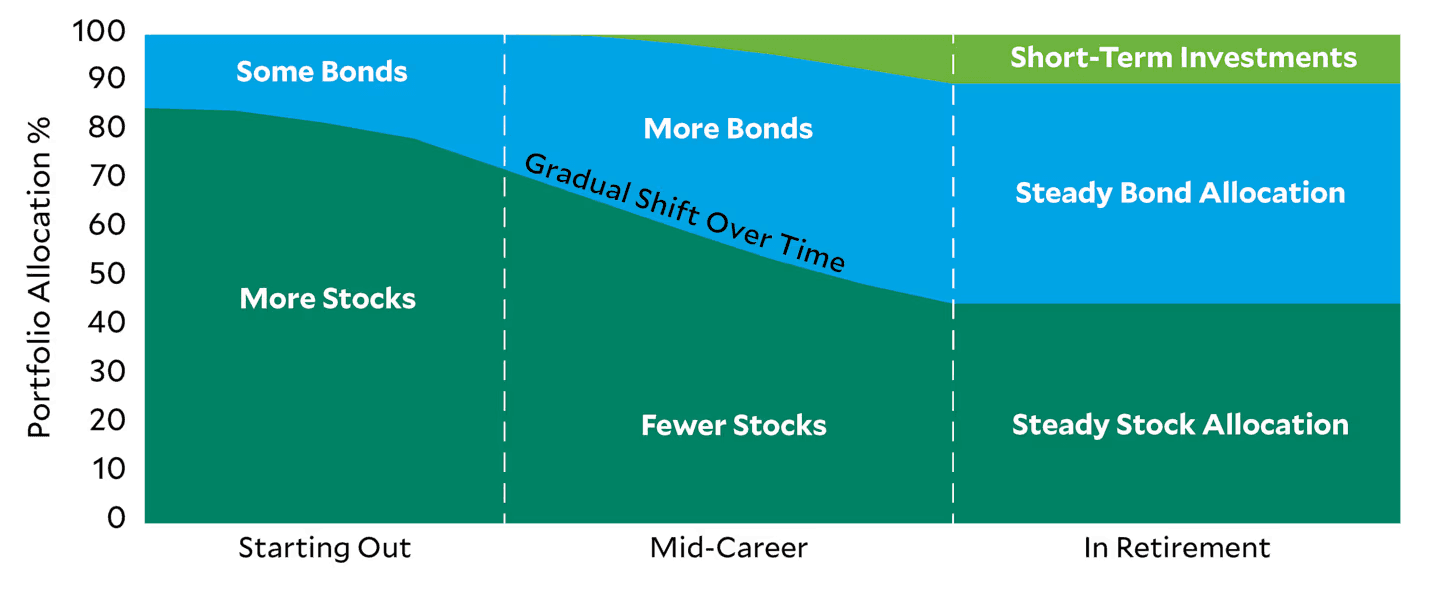
For each, a fixed income allocation supplies a non-equity asset to spend from — or to rebalance out of when equities are cheap — so equities are never sold at the bottom. That is protection no average annual return figure captures.
Bond Funds vs Individual Bonds: A Distinction That Damages Trust
Much client skepticism traces to one confusion: bond funds vs individual bonds. "My bond fund went down" is the most common objection, and it is technically correct — but it misreads what a bond does.
What Advisors Should Clarify With Clients
An individual bond held to maturity returns principal plus coupons, barring default. Interim price moves are noise if the client holds.
A bond fund never matures. Its NAV floats with rates, so in a rising-rate year it can post a real, visible loss.
Neither is wrong to own — but conflating them erodes the client trust that is hardest to rebuild once it slips. Advisors who explain the difference upfront turn a source of doubt into a demonstration of expertise.
A Framework for the Client Conversation
Pulling it together, a simple structure for the meeting:
Lead with role, not return. Bonds manage risk; they are not there to win.
Set correlation expectations. Diversification is strong but regime-dependent.
Make it personal. Tie the allocation to the client's own liquidity needs and horizon.
Clarify the vehicle. Distinguish funds from individual bonds before doubt sets in.
Positioning Bonds as a Behavioral Tool, Not Just a Return Driver
The deepest reason why hold bonds in a portfolio is behavioral. The return a client actually earns depends on whether they stay invested. An allocation that prevents one panic-sale in a bear market can outweigh years of modest performance drag — and that is the number advisors should help clients see.
Automate the Thesis with Surmount Wealth
Understanding why hold bonds in a portfolio is one thing — executing that logic consistently across client accounts is another. That's where Surmount Wealth comes in.
Surmount is an AI-driven, automated investing platform that lets you build, backtest, and automate any investment thesis — including the regime-aware, drawdown-conscious approach above — and apply it to existing brokerage accounts. No fund transfers. No code from scratch.
Picture a hypothetical "Regime-Aware Ballast" strategy (illustrative only, not a recommendation): it monitors the rolling stock-bond correlation and, when the relationship turns positive in an inflation-driven regime, systematically tilts the defensive sleeve toward shorter-duration and other uncorrelated assets — then reverts as the diversification signal reasserts. The point isn't this specific rule; it's that any thesis you can define, Surmount can automate and test.
Why advisors use Surmount:
Strategy library + custom builds — deploy prebuilt algorithms or codify your own thesis.
Backtesting before capital — validate drawdown behavior across historical regimes.
No account migration — automate on top of existing brokerage accounts.
Systematic discipline — close the behavioral gap that erodes client returns.
Advisor-grade controls — professional tooling built for portfolio managers, not retail guesswork.
Book a demo now → and see how fast your next thesis becomes an automated, testable strategy.
Hypothetical strategies are illustrative only and do not constitute investment advice or a recommendation.
FAQ: Why Hold Bonds in a Portfolio
Why hold bonds in a portfolio?
Bonds manage risk, not return. They provide portfolio drawdown protection and liquidity, so clients aren't forced to sell equities at a loss during a downturn.
Do stocks and bonds still correlate?
Usually inversely — but the stock bond correlation is regime-dependent. In inflation-driven selloffs like 2022, both can fall together, which weakens the diversification benefit.
Are bond funds like individual bonds?
No. The bond funds vs individual bonds distinction matters: an individual bond returns principal at maturity, while a fund never matures, so its NAV drops when rates rise.
What is sequence of returns risk?
Sequence of returns risk is the danger that early losses — not average returns — derail a plan. A fixed income allocation cushions a client forced to sell during a drawdown.
How much fixed income should clients hold?
It depends on time horizon and liquidity needs. The aim is enough uncorrelated assets to dampen drawdowns without capping long-term growth.