Multi-Generational Portfolio Management: Best Practices

Multi-Generational Portfolio Management: Best Practices
Advisors managing wealth across two or more generations face a structural problem that standard portfolio theory does not fully address: how do you build a portfolio designed to function correctly for twenty, thirty, or even fifty years, across ownership transitions, shifting risk tolerances, and multiple sets of beneficiaries? Multi-generational portfolio management requires a framework built for durability, not just performance — one that can absorb decades of market cycles, tax law changes, and family transitions without requiring constant manual intervention.
This is different from standard long-term investing guidance. A single investor's twenty-year horizon assumes one decision-maker, one risk profile, and one time frame. Managing a portfolio across generations must account for multiple decision-makers, evolving objectives, and often legal structures like trusts that constrain how and when assets can be reallocated.
Why Multi-Generational Portfolio Management Requires a Different Framework
The core challenge is that the assumptions embedded in a typical retirement-focused plan don't hold up over a genuine multi-decade investment horizon. Risk tolerance is not static across three generations of stakeholders. Tax treatment changes. Beneficiaries take on different levels of involvement over time, from a founding client to heirs who may never speak with an advisor directly.
This is not a small planning consideration — as we've covered in our analysis of the $124 trillion wealth transfer, Cerulli Associates projects that roughly $124 trillion in assets will transfer through 2048, with the majority moving from Baby Boomers and older generations to heirs and charitable causes. Intergenerational wealth planning at this scale requires portfolios that were never designed to depend on a single generation's time horizon.
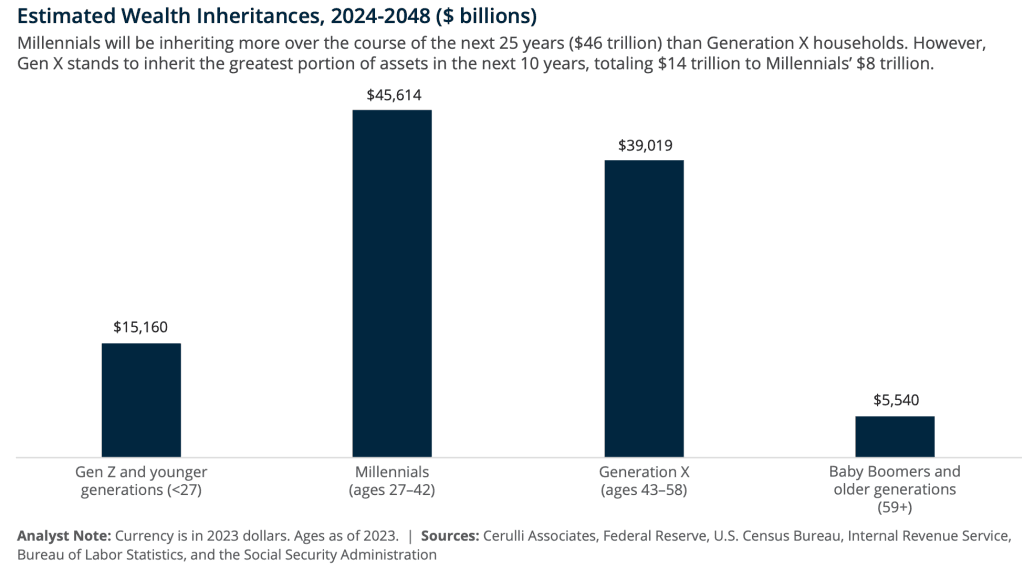
That is why treating a legacy portfolio as a "set it and forget it" position often works against a household's long-term interests, even when performance looks strong on paper.
Core-Satellite Portfolio Strategy as a Multi-Decade Foundation
A core-satellite portfolio strategy is one of the more durable structural answers to this problem. The "core" sleeve — typically diversified, low-cost, broad-market exposure — is built to persist largely untouched across market cycles and, often, across generations. The "satellite" sleeve allows room for tactical positioning, concentrated conviction holdings, or thematic exposure that can evolve as objectives shift.
Balancing Stability and Tactical Flexibility Across Generations
This structure gives advisors a practical way to manage competing priorities:
Preserving compounding — the core sleeve keeps working undisturbed across decades
Allowing expression — each generation of stakeholders gets room for updated views
Avoiding disruption — changes happen at the satellite level without unwinding the whole portfolio
It also creates a natural handoff point, since the core sleeve doesn't need to be renegotiated every time a new decision-maker enters the picture.
Rules-Based Rebalancing for Long-Horizon Portfolios
Over decades of holding a portfolio, rebalancing discipline compounds in importance. Vanguard's research on target-date fund rebalancing found that a threshold-based approach was expected to generate higher annual returns than conventional calendar-based rebalancing, largely by keeping portfolio drift closer to its intended target through volatile periods. For multi-generational portfolio management specifically, rules-based rebalancing removes a dependency on any single decision-maker remembering, or wanting, to act.
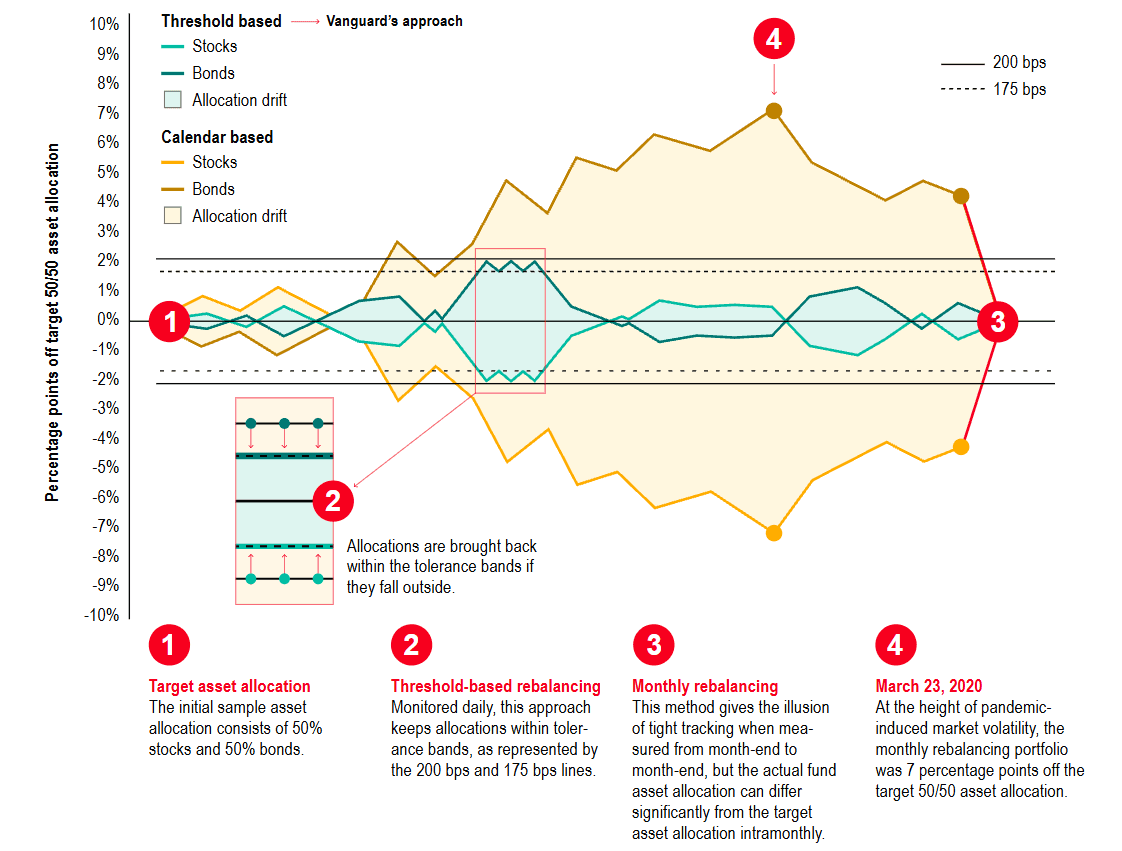
Why Automated Portfolio Rebalancing Outperforms Manual Discipline
Manual rebalancing depends on consistent attention from whoever currently holds decision-making authority, which is exactly what tends to break down as accounts change hands across decades. Automated portfolio rebalancing applies the same threshold or calendar-based logic every time, regardless of who is nominally in charge of the account that quarter, which matters enormously when oversight is rarely continuous.
Managing Concentrated Positions in Legacy Holdings
Multi-generational portfolios frequently carry a legacy position — stock inherited from a founder, an employer, or an early conviction bet — that has grown disproportionately large relative to the rest of the portfolio. CFA Institute research on portfolio concentration highlights the importance of setting explicit position-size limits, the same discipline behind systematic sell signals, rather than letting a single holding's outperformance quietly expand its share of total risk. Concentrated position management becomes especially important across generations, since a legacy holding's tax basis, the account structure it sits in, and the family's emotional attachment to the position can all complicate what should be a straightforward, tax-efficient trim.
Tax-Efficient Wealth Transfer Across Trusts and UTMAs
Tax-efficient wealth transfer — closely tied to broader tax diversification strategy — sits at the center of multi-generational portfolio management. Assets held in trusts, UTMAs, or other transfer vehicles are often subject to different tax treatment than a standard taxable account, and coordinating investment strategy with these structures can meaningfully affect after-tax outcomes for the next generation.
Coordinating Trust and UTMA Portfolio Management With Investment Strategy
Trust and UTMA portfolio management is not simply a legal or custodial exercise — it directly shapes what kind of investment strategy makes sense:
A trust with specific distribution terms may require a different liquidity profile than a discretionary account
A rules-based approach can be configured to reflect those constraints consistently
This removes reliance on ad hoc judgment calls each time a distribution is due
Structuring Portfolios for a Multi-Decade Investment Horizon
Ultimately, multi-generational portfolio management is less about picking the right securities and more about building a structure that keeps working after the original decision-maker is no longer the one making decisions. A defined core-satellite framework, systematic rebalancing rules, explicit position-size limits, and tax-aware coordination with trust or UTMA structures together form a framework that can reasonably be expected to hold up across a genuine multi-decade investment horizon, rather than one that depends on any single advisor or family member's ongoing attention.
Conclusion
Multi-generational portfolio management asks advisors to design for a future they will not fully control. Market cycles, tax law, and family composition will all shift in ways that cannot be predicted decades in advance. What can be built now is a durable structure — one where rules-based rebalancing, disciplined position sizing, and coordinated trust or UTMA planning do the ongoing work that a single decision-maker cannot reliably sustain across generations.
Turn This Framework Into an Automated Strategy — Explore Surmount Wealth
Everything above is a sound framework on paper. The harder problem — the one that actually determines whether a multi-generational portfolio stays disciplined for thirty years — is execution. Rebalancing thresholds, position-size limits, and trust-aware liquidity rules only work if they're applied consistently, every quarter, regardless of who's currently overseeing the account.
That consistency is exactly what Surmount Wealth is built to deliver.
Surmount is an AI-driven, automated portfolio management platform that lets RIAs and portfolio managers build, test, and automate rules-based strategies directly on top of clients' existing brokerage accounts — no fund transfers, and no need to code a system from scratch.
A Hypothetical Illustration: The "Generational Core-Satellite" Concept
To make this concrete, consider a hypothetical rules-based strategy an advisor could construct and test on Surmount's platform:
Core sleeve rule: Broad-market exposure rebalanced automatically whenever allocation drifts beyond a defined threshold (e.g., 5 percentage points from target)
Satellite sleeve rule: A capped allocation (e.g., no more than 15% of total portfolio value) reserved for concentrated or thematic positions, with automatic trim triggers if any single holding exceeds a defined ceiling
Legacy position rule: A scheduled, tax-aware trimming cadence for an inherited or long-held concentrated stock position, designed to reduce single-name risk gradually rather than all at once
Important disclosure: This is a hypothetical illustration for educational purposes only. It does not reflect an actual Surmount strategy, is not based on backtested performance, and should not be construed as a recommendation to buy, sell, or hold any security. Any real strategy would need to be built and evaluated based on a specific client's objectives, constraints, and risk profile, with compliance review prior to use.
Why Advisors Explore Surmount for This Kind of Work
No manual rebalancing drag — thresholds execute automatically, without depending on any one person remembering to act
No fund transfers required — strategies run on top of clients' existing brokerage accounts
Built for testing before committing — advisors can construct and evaluate a rules-based concept before considering it for live use
Designed for continuity — automation doesn't depend on which family member or advisor currently holds oversight
Access to a strategy library — professional-grade, rules-based frameworks advisors can review, adapt, and test
If you're already thinking in terms of core-satellite structures, rebalancing rules, or tax-aware trimming for multi-generational clients, Surmount gives you a way to test those ideas systematically rather than tracking them by hand across decades.
Book a Demo with Surmount Wealth →
FAQ: Multi-Generational Portfolio Management
What Is Multi-Generational Portfolio Management?
Multi-generational portfolio management is the practice of structuring a portfolio to function correctly across decades and multiple decision-makers, rather than a single investor's time horizon.
Why Use a Core-Satellite Portfolio Strategy?
A core-satellite portfolio strategy preserves long-term compounding in the "core" sleeve while allowing tactical or thematic exposure in the "satellite" sleeve without disrupting the whole portfolio.
How Often Should Rules-Based Rebalancing Occur?
Rules-based rebalancing is typically triggered by a set threshold or calendar schedule rather than a fixed frequency, keeping portfolio drift consistently in check.
Who Benefits From Automated Portfolio Rebalancing?
Automated portfolio rebalancing benefits any household where oversight changes hands over time, since it removes dependence on a single decision-maker's ongoing attention.
When Should Trust and UTMA Portfolios Be Reviewed?
Trust and UTMA portfolio management should be reviewed whenever distribution terms, tax treatment, or family liquidity needs shift, not on a fixed annual basis alone.